

EVOLUTION
OF THE SPECIES
How the MODX 70 is reinventing the sailing catamaran

A distillation of ideas from two high-tech projects, the MODX 70 represents a new breed of “energy-sober” sailing catamaran. Sam Fortescue explores the innovation-packed first hull
Boil the MODX down to a single word, and I come up with “why?” Not because I don’t see the point of the boat – far from it. But because there’s simply so much innovation crammed in that it can only be the result of a relentlessly questioning mind; one that has weighed the reasoning behind every standard feature of a sailing catamaran.
“Why” has led to some unusual conclusions. With the aim of eliminating carbon emissions, the MODX is fully electric with never-before-seen inflatable wing sails that require neither rig nor stays. Some four years in development, the boat has swept up plaudits.
“It’s pure disruption. The boat is energy smart, so you consume just what you produce. It represents a new way to sail”

To understand how this four-cabin world-touring cat came to be, cast your mind back to 2008. The yard was just starting work on the first of eight identical MOD 70 trimarans for serious, adrenaline-laced ocean racing. After that, it refitted the radical Race for Water, a kite-driven solar platform whose mission was to circle the planet using just renewable energy.
The MODX 70 is the direct offspring of these two projects, marrying elements of both and drawing on the expertise acquired over nearly two decades. “With this combination of experience, the ambition of the MODX 70 was to create the first 100 per cent electric and energy self-sufficient yacht for the highend yachting market,” explains chief commercial officer Jean Guyon.

“It’s pure disruption. The boat is energy smart, so you consume just what you produce. It represents a new way to sail. You must have a different mindset: you can’t decide to sail to an island 25 miles away with no wind, stop for lunch and be back in the evening. It’s going to appeal to a bluewater sailor.”
That’s because there is no fossil fuel backup for the electrical system. Twin 40kW motors draw on a huge lithiumion battery pack of 250kWh, which gives a range of around 120 nautical miles at a parsimonious five knots. A staggering 70 square metres of solar panels produces about 15kW at midday, while a hydrogeneration system can produce about the same again from the turning of the boat’s propeller under sail, topping up the battery.
“That’s also why we needed to design and build a relatively light boat with a high length-to-width ratio,” says Stéphane Dérobert of naval architects VPLP. “This slenderness guarantees performance, and performance guarantees electric autonomy. It’s the key to the virtuous circle that Franck David [of Océan Développement] wanted to achieve from the very beginning of our discussions.”
The point is to rely on the wind and make navigation decisions accordingly. “Since I started sailing this boat, I look at the weather forecast much more,” says Guyon with a grin. And to that end, the MODX team has put in a solution that has never been tried before.
Two Aeroforce vertical wingsails on the yacht’s coachroof replace the more familiar main and jib, doing away with spars and rigging at the same time. Developed by a sister company run by Guyon, each wing has an area of 125 square metres when fully inflated around a telescopic mast. And they are said to be 1.7 times more efficient at propelling the boat than traditional sails.
The wings are a technical triumph in their own right. Made of fabric, they take around eight minutes to inflate. They swivel through 360 degrees, so you can raise, reef or lower them with the wind at any angle. And it’s all computer controlled, so you simply prod at the touchscreen controls to make the whole thing swing into action.
With all the novel technology, it is easy to overlook the fact that the MODX is a very comfortable platform for family cruising
Reefing is almost unnecessary. That’s because of a unique throttle that fine-tunes the wings’ angle of attack to the wind. At 100 per cent, it harnesses the full lift available, but as you slide the throttle forward it rotates the wings into the wind to spill power. It all feels a bit Starship Enterprise, allowing you to dial the power up and down very easily.
“It can be operated by one person only from the digital interface,” says Guyon. “This makes the sailing experience accessible to motorboat users. The wing systems are controlled basically like an engine, only this engine is powered by the wind.”


Performance is excellent in light airs, where the wing is at its most effective relative to traditional flexible sails. The MODX matches wind speed up to around 10 knots and tops out at around 15 knots of boat speed in 20 knots of wind. “The performance is very comfortable,” says Guyon. “You want to stay below 16 knots of boat speed, otherwise it’s a bit too much stress, but we’ve hit 22 knots on occasion. The sweet spot is in 15 to 20 knots of wind.”
With all the novel technology on board, it’s easy to overlook the fact that the MODX is fundamentally a very comfortable platform for family cruising and charter. It is conceived in two versions – one dedicating much of the starboard hull to the owner with two guest cabins to port; the other splitting each hull into a double and a twin cabin (all en suite). There are also two handy cabins in the forepeak with bunks for up to four crew or smaller guests.
RAISING A WING

In contrast to the rigid wings used by the America’s Cup catamarans, Aeroforce wings are made of flexible material such as PVC. In the stowed position, the material is clamped easily in a curved receptacle a little like a Park Avenue boom with the telescopic mast retracted. To raise the wing, the automatic system first rotates the booms head to wind. Then it inflates the sail with air, which it maintains at a constant pressure with periodic flurries of pump activity.
The computer collects wind data from the instruments and makes minute adjustments to keep the wing at the optimum angle. Because the wings are unstayed, there is nothing to stop them from rotating all the way round, so when the wind is abaft the beam, the foil can also be oriented aft. Tap the reef button and the telescopic mast falls to half height, while air is vented from the wing. In the event of power loss on board, or if the emergency stop button is pressed, the wing crumples to the coachroof under gravity alone.
In contrast to the rigid wings used by the America’s Cup catamarans, Aeroforce wings are made of flexible material such as PVC. In the stowed position, the material is clamped easily in a curved receptacle a little like a Park Avenue boom with the telescopic mast retracted. To raise the wing, the automatic system first rotates the booms head to wind. Then it inflates the sail with air, which it maintains at a constant pressure with periodic flurries of pump activity.
The computer collects wind data from the instruments and makes minute adjustments to keep the wing at the optimum angle. Because the wings are unstayed, there is nothing to stop them from rotating all the way round, so when the wind is abaft the beam, the foil can also be oriented aft. Tap the reef button and the telescopic mast falls to half height, while air is vented from the wing. In the event of power loss on board, or if the emergency stop button is pressed, the wing crumples to the coachroof under gravity alone.
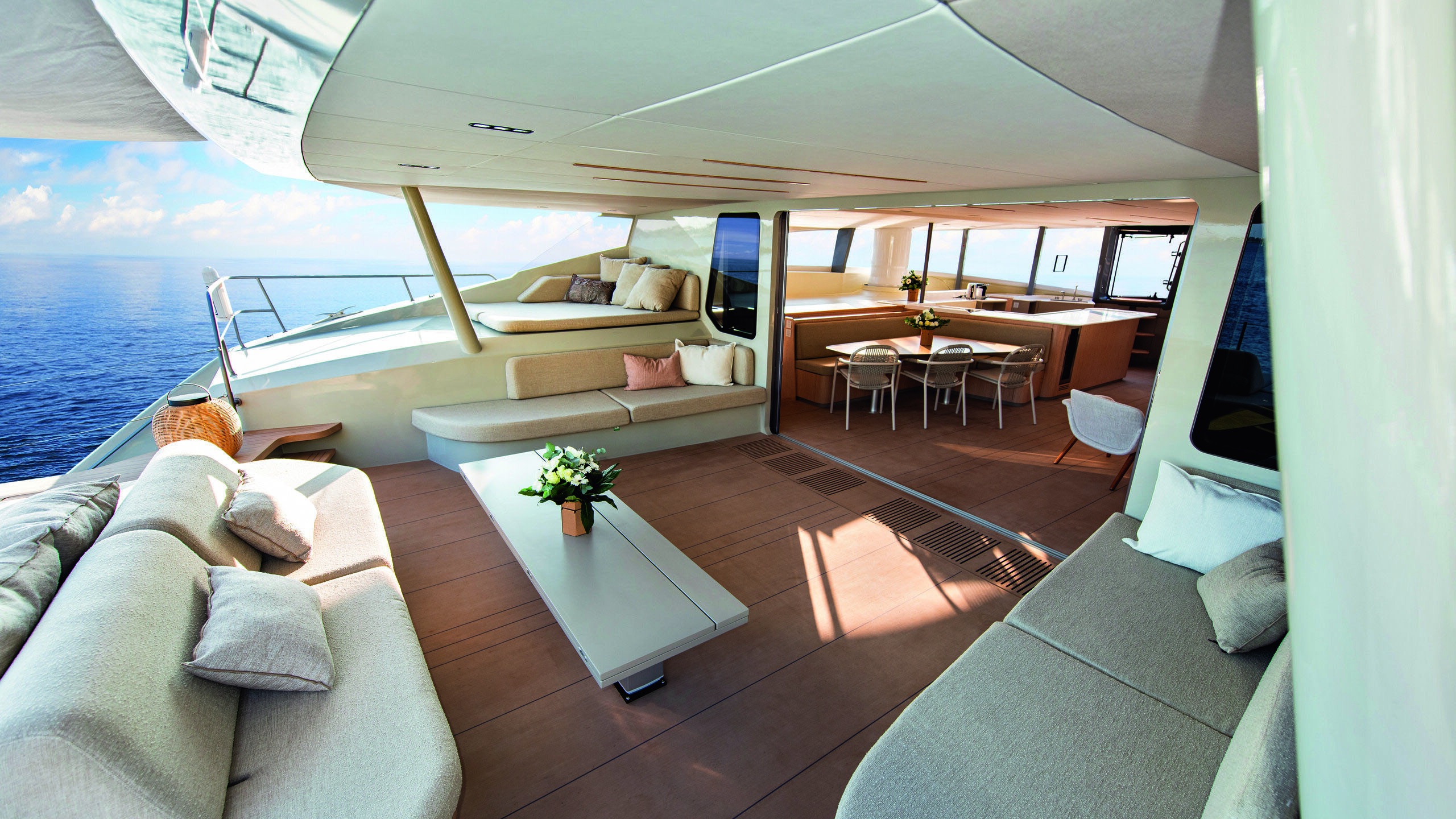
Indoor living is concentrated in the magnificent saloon that bridges the two hulls. It has an elegant U-shaped galley to port with Corian work surfaces and Bosch or Siemens appliances, including a dishwasher and induction hob. A table for at least six lies aft of this, designed in such a way that the surface can be used as a kind of breakfast bar. To starboard is an array of fixed and free-standing sofas including a fine daybed perch up on the panelling that encloses the accommodation below.
Headroom is excellent, and that makes for tall windows that let natural light flood in. The navigation station is positioned at the front of the superstructure. With no sails to trim, there is no need for any control lines and there is not a winch to be found aboard. The only reminders inside that the boat is wind powered are the gleaming white tubes that rotate the wings above. This is true push-button sailing.

|| OCÉAN DÉVELOPPEMENT - MARTIN VIEZZER
|| OCÉAN DÉVELOPPEMENT - MARTIN VIEZZER
Windows on either side of the helm open and let you clamber out onto the foredeck via a ladder. You might think twice about it underway, because those reverse bows will send up a fine spray, but there’s still fun to be had dolphin-watching from the trampoline or lounging on cushions looted from the saloon.
Naturally, the aft deck offers more space and comfort, with sofas lining its three sides and a highlow table aft. There’s lots of open space here, as well as convertible sun lounging aft and a couple of roosts up on the coaming, which give both protection from sun and wind and a glorious view of the ocean sliding past. The design doesn’t allow for a lowering bathing platform, but there are wide steps down to the skirt of each hull where you can fit a bathing ladder or a lightweight carbon gangplank.
Mindful that the carbon emissions involved in building a boat are also significant, the yard has used biosourced InfuGreen resin to infuse the hull, which is mostly fibreglass, with just 25 per cent carbon reinforcing in key spots. “Carbon extends the lifespan of the boat,” says Guyon. Other eco-minded decisions include using composite decking from Esthec, made of recycled, biosourced and natural ingredients. And the headlinings are made of Varian, a hard-wearing fabric woven from flax and corn starch.
Having backed this idea mostly with their own funds, the shareholders are keen to start selling boats. To this end, they have taken perhaps the only false step in the project, by offering a flybridge option.
It is fitted at the back of the coachroof and is necessarily small to avoid the turning circle of the wings. Guyon dismisses my concerns and says the flybridge slightly increases the area of solar panels with its little hardtop. No doubt it offers a good vantage point, but it seems out of step with the spirit of the design.
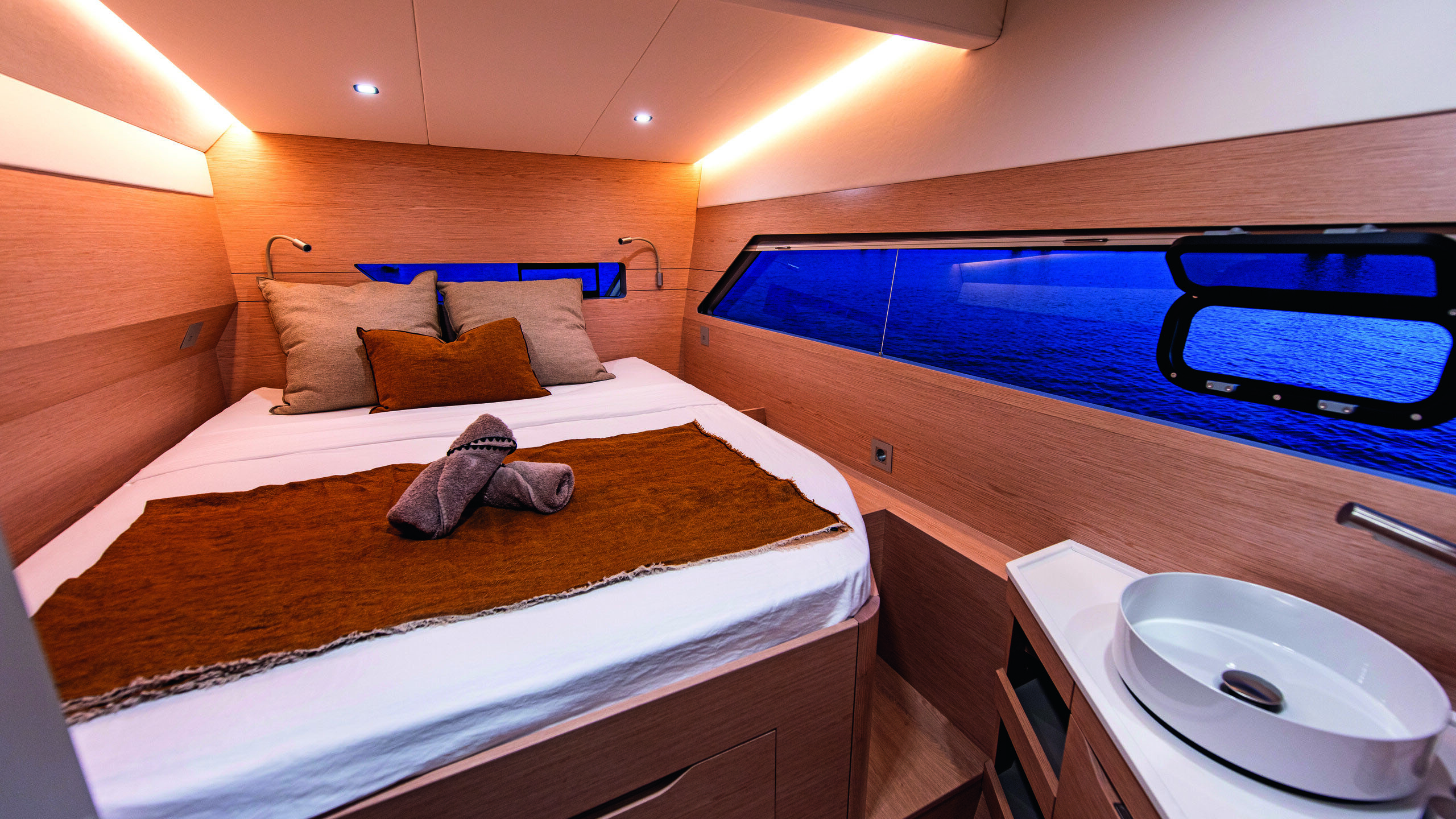
Hull windows are fitted with opening portholes for ventilation, giving each cabin fresh air and natural light
All the same, there is something deeply attractive about this yacht. In an age of increasingly elaborate luxury, it is extremely comfortable without being showy. And at its core is the idea of “energy sobriety” – a wonderful French term that just means being reasonable and going further under sail.
Given the yard’s capacity of building three to four boats per year, you won’t see many of these on the oceans. But when you do, you won’t mistake them for anything else.
First published in the June 2026 issue of BOAT International. Get this magazine sent straight to your door, or subscribe and never miss an issue.


LOA 21.33m | Guests/crew 8-10/2-3 |
Beam 10m | Sail area 2 x 100m2 |
Draught 2m | Electric motors 2 x 40kw |