

LIVING LEGEND
Inside the 105-year restoration of historic steam yacht SS Delphine

Fresh from a major technical refit and still cruising under her original steam engines, 105-year-old SS Delphine is revived and ready for charter – but her journey has been far from straightforward, finds Katia Damborsky
On a mild spring day in 1921, more than a thousand people flocked to the construction halls of Great Lakes Engineering Works in Michigan, one of the region’s leading shipbuilders. They had heard that there would be a milestone launch taking place at the shipyard.
Not a freighter or a tugboat, as was a common sight in the Great Lakes State, but something far grander: a steam yacht measuring 78.5 metres. It would be the largest privately owned American steam-powered yacht by tonnage and indeed, would have been even longer and larger had it not been for the physical constraints of the shipyard’s location and the network of canals that lead to open water.

SS Delphine sails again after being out of commission for five years. A recent 14 months of drydock in Marseille restored her machinery || CREST COMPANY/CRISTOBAL BLAIS
SS Delphine sails again after being out of commission for five years. A recent 14 months of drydock in Marseille restored her machinery || CREST COMPANY/CRISTOBAL BLAIS
Most spectators had travelled from nearby Detroit by streetcar, which had a regular route between the city centre and the shipyard’s site at River Rouge. Some of the wealthier visitors would have come in their own vehicles, perhaps in a new Ford Model T that Henry Ford was busy assembling just a stone’s throw away, in a factory just north of the Detroit River.
Te


When she was owned by the Dodge family, her boat deck would be adorned with giant Persian rugs. Later owners added the pool || CREST COMPANY/CRISTOBAL BLAIS
When she was owned by the Dodge family, her boat deck would be adorned with giant Persian rugs. Later owners added the pool || CREST COMPANY/CRISTOBAL BLAIS
But the party that owned the yacht arrived in a convoy of limousines. Through the windows, they gazed out at Delphine poised on the hard, partially covered by scaffolding and propped up by blocks.
An American flag was attached to the bow, bearing the 48 stars that represented the US states at the time. As the owners exited the limousines, a band began to play and a champagne bottle was pressed into the arms of Delphine Dodge Cromwell, the eponym of the yacht in front of them.
Delphine’s mother, aunt, brother, husband and in-laws all watched as she smashed the champagne bottle on the hull and Delphine slipped, with a dramatic list that soaked those who were witnessing the launch from on board, into the rusty waters that give River Rouge its name.

SS Delphine has wide side decks for promenading || CREST COMPANY/CRISTOBAL BLAIS
SS Delphine has wide side decks for promenading || CREST COMPANY/CRISTOBAL BLAIS
Notably absent from the launch was Delphine’s father, Horace E Dodge, who had died just four months before seeing his yacht complete. His brother and business partner, John Francis Dodge, had also died 15 months prior.
It was a bittersweet moment for the family, and many watched from under black mourning veils as the Dodge family’s pride and joy began her life without the people who had originally conceived her. Perhaps they were anxious too, about the possibility of being saddled with the upkeep of such an extravagant and complex vessel (one of about eight vessels that Horace E Dodge owned at the time of his death).
In the end, though, they needn’t have worried. “I don’t think Delphine or Anna [Horace’s wife] had a daily job to do the coordination and follow everything such as the payments, contracts, catering and so on,” says Ineke Bruynooghe, author of the historical book SS Delphine: Chronicle of Horace Dodge’s Steam Yacht. “That would have been more than a full-time job!”

Bruynooghe is the authority on the history of SS Delphine (as the yacht is now known – she was launched as simply Delphine). Her father previously owned the yacht for almost 20 years, and it was under the Bruynooghe family that she underwent a six-year €40 million (£34.3m) refit beginning in 1997.
Given the care that went into her build, perhaps Horace Dodge would not be surprised to learn that SS Delphine is still sailing more than a century later on her original steam engines. But since her launch, SS Delphine has seldom seen a dull year.
Her first five years were spent attending sailing and speedboat races across the US – the Dodge family had an affinity for speed – and travelling between New York, their Palm Beach estate and their Great Lakes home, where the family built a 61-metre pier through their manicured gardens and out over the water.

In 1926, the yacht caught fire and sank on the Hudson River, and after being restored she enjoyed a quiet few decades of operations, until being commandeered by the US Navy and renamed USS Dauntless in 1942, serving as the flagship for Admiral Ernest King in the Second World War.
This would have disappointed her commissioning owner – it has been theorised that Horace Dodge had deliberately incorporated certain design choices into Delphine to prevent this from happening, having already seen two of his previous yachts requisitioned during the First World War.
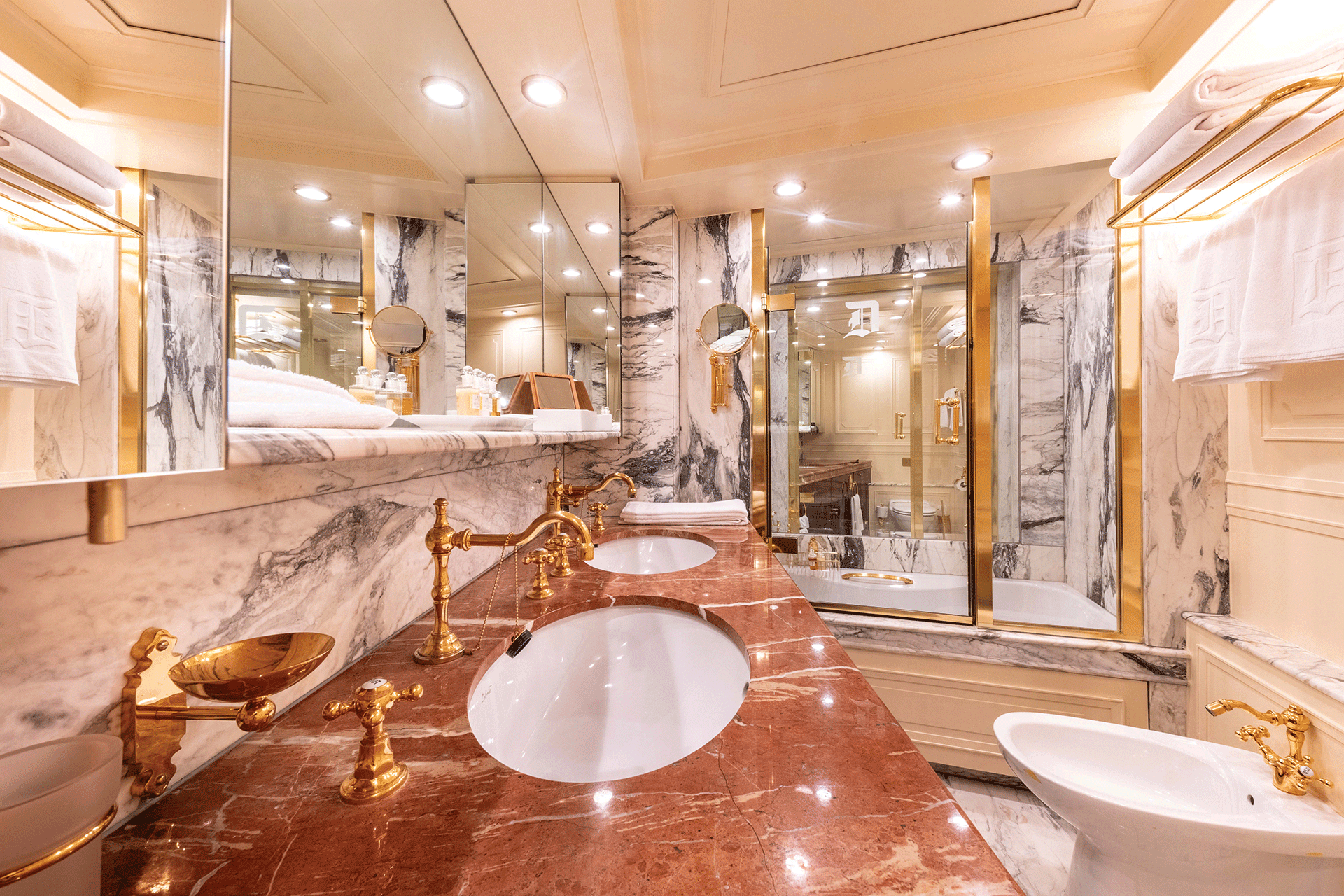
The majority of her life after that passed in various states of disrepair or in short stints as a boutique cruise ship and as a training ship for aspiring mariners. Her much-needed restoration undertaken by the Bruynooghe family in the 1990s gave her a new lease of life, perfectly replicating the Tiffany-era interiors that the Dodge family lovingly installed.
She became available for select, private charters, and her size and her history as a registered passenger ship made her particularly popular for events, such as weddings. This was how she came under the eyes of her current owner.

|| CREST COMPANY/CRISTOBAL BLAIS
|| CREST COMPANY/CRISTOBAL BLAIS
“[The current owner] got married on the boat in 2008, with 200 people, the Monte-Carlo Philharmonic Orchestra and fireworks,” says Maxime Berisset, owner’s rep, director of the management company and project manager. “His wife fell in love with the boat, so they chartered her for another week.” Neither could get SS Delphine out of their minds. A few years later, the vessel was bought as a wedding anniversary gift for the wife.
The owner was adamant about “preserving a piece of history”, says Berisset. But preserving history comes at a cost. The owner has invested close to €100 million in total during the past decade. Some of that investment included the yacht’s latest refit, which began in May 2025 and ended in July 2026. On paper, it lasted a little over a year. In reality, it marked the end of a much longer, more tumultuous chapter.
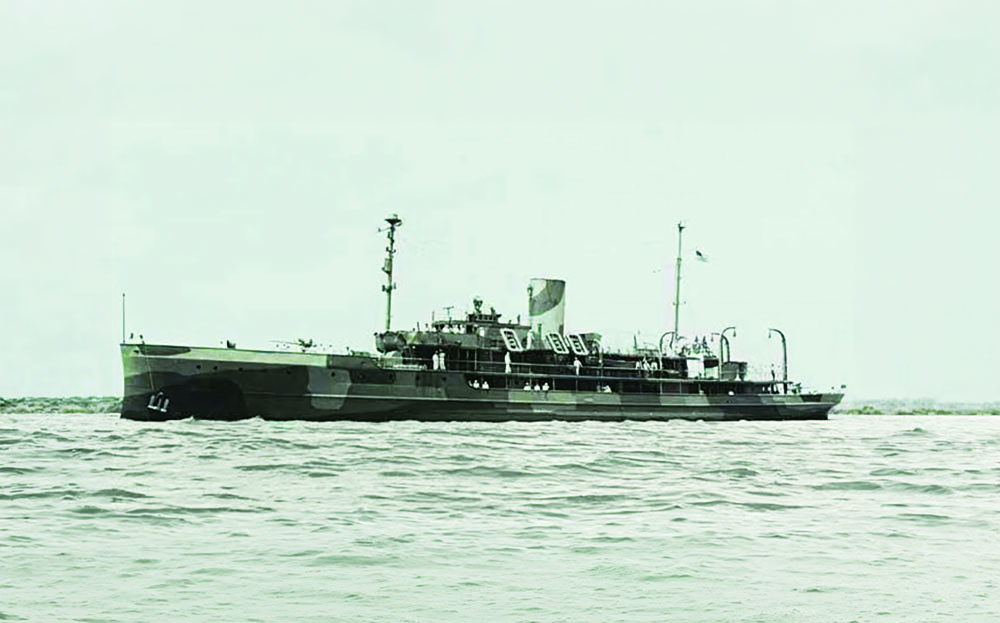 Delphine is launched as one of the
most ambitious private yachts of
her era, complete with 10 guest
cabins, Tiffany & Co interiors
and a complex and massive
Aeolian pipe organ.
In 2021, SS Delphine entered what was intended to be a standard months-long refit at a shipyard in the South of France. Instead, a disagreement about the scope of the refit immobilised the yacht for several years. Eventually resolved, the owner asked Berisset to take over the vessel and the refit, and he found the yacht in poor condition.
“For those who ‘get’ her, being on board is much more than a charter - it is the privilege of living on a piece of maritime history”
Back at the start of the original refit in 2021, tasks had been started but weren’t finished, sections of the deck had been dismantled and various other parts of the vessel were removed in preparation for the works and had been subsequently misplaced or damaged.
Vanja Petrović, chief engineer on board, recalls that the parts had not been properly documented because those overseeing the refit had expected the project to be completed quickly.

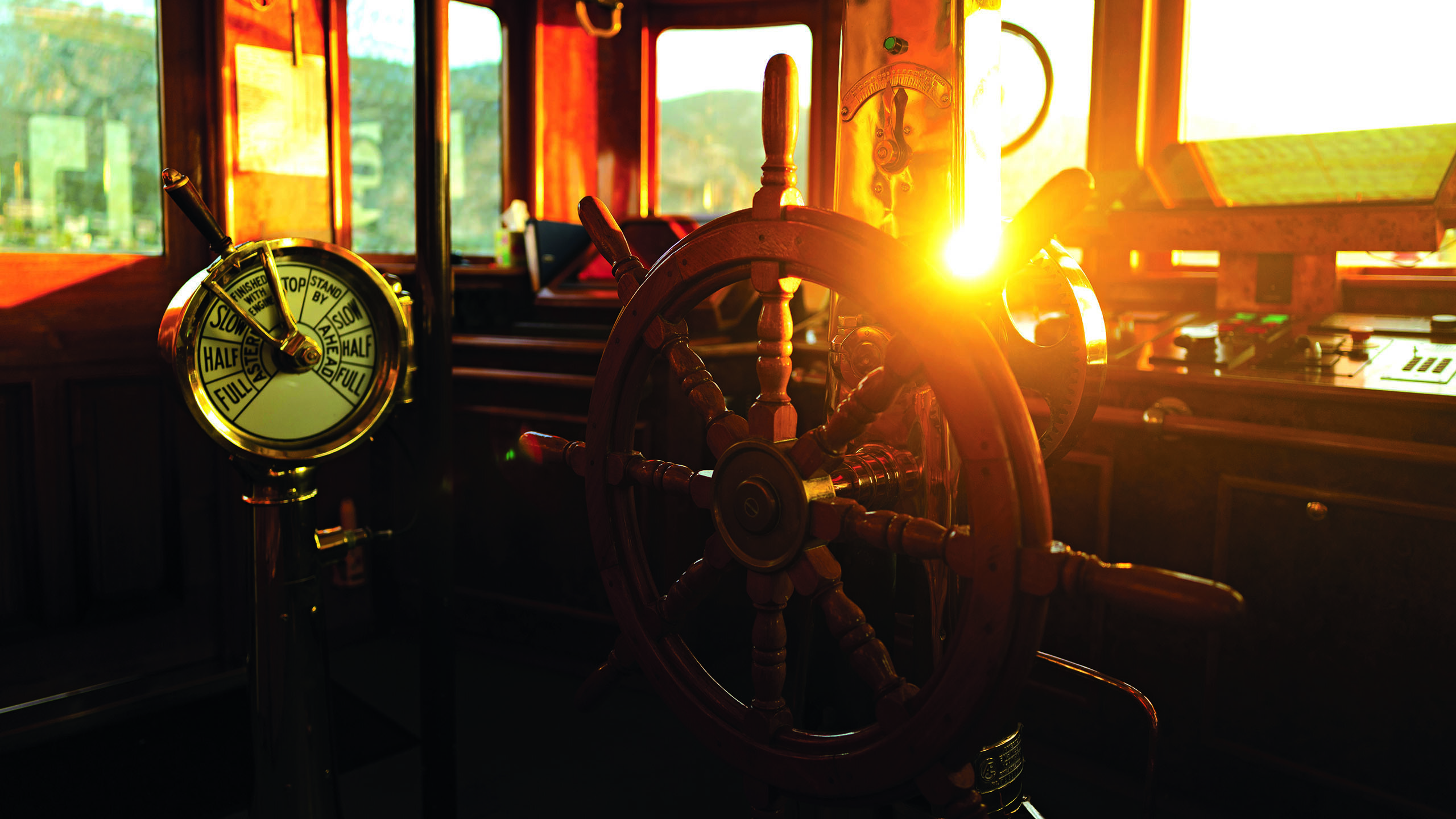
The steering equipment had been removed, crucial components were missing, the windlass was broken and mechanical parts had disappeared. The engine room was exposed, with holes in the boilers large enough for Berisset to put his entire hand through. The team transported the yacht by tow boats to another shipyard in Marseille, where the damage could be assessed and the restoration could begin.
Berisset took a two-pronged approach to the work. First, rather than relying exclusively on the specialist suppliers normally associated with superyacht refits, he looked to Marseille’s wider industrial network. Many local companies were initially nervous about working on a yacht of SS Delphine’s age. Case in point, 10 companies came to inspect the windlass before one agreed to take it on.

“We found one guy in Mandelieu in a small workshop, all alone, who came and said he could copy the part in a few days,” recalls Berisset, who says the strategy was to exclude any yachting contractors and replace them by artisans or industrial contractors, for a third of the price.
The hydraulics presented another challenge. “We found a company in La Crau that had never worked on a yacht,” says Berisset. The crew gave them old photographs and workers from the company subsequently arrived to take measurements, “with the ruler that you measure your kitchen with”, says Petrović.
He was dubious about whether they could recreate components for a system operating at high-pressure 50 bar, “but these guys did a miracle, honestly”.
Even Babcock Wanson, the original boiler manufacturer, sent two welders who spent more than a month repairing the two boilers (Delphine originally had three). Almost every task on the yacht was undertaken by independent contractors. Captain Viky Virtanen describes the philosophy neatly: SS Delphine was restored by people who were “experts in their field” rather than necessarily people who understood “yachts” as a whole.
“The current owner got married on the boat in 2008, with 200 people, the Monte-Carlo Philharmonic Orchestra and fireworks. His wife fell in love with the boat”
The second part of the restoration was just as important – bringing back the people who knew the yacht. Many crew members had left while the yacht languished in the shipyard, but Berisset managed to convince most to return, in some cases as consultants for the refit. Among the most important was retired former chief engineer Willem Outtier, who had supervised the Bruynooghe restoration in the 1990s. His key task then had been rebuilding the engines from scratch.
In 2025, he returned to help with their repair and maintenance. “In my opinion, it would have been easier and cheaper to install new engines,” he admits, pointing out that parts of the old engines still need to be lubricated manually. “But that would have been such a shame.”
The machinery had presented a headache from the beginning. “We must not forget that the experience and knowledge from that time can no longer be found anywhere,” Outtier notes. “We had to rely on the existing drawings of the engines. Most of the drawings corresponded with reality, but some did not.”
Outtier, now retired, no longer works on the vessel, but the crew still calls him with questions. Barry Delgado, the current third engineer, describes him as their “bible” for everything related to the machinery.
These days, the chief engineer is Petrović, a man who didn’t stumble into the complex world of steam-powered machinery overnight: his dad worked on SS Delphine, and he was taught to operate the engines by his father. Most of the other crew also have some kind of personal connection to the yacht.
Karolina Rudzka, first officer, spent nine years working on SS Delphine and she developed a connection to the yacht the day she signed for the role of relief captain. “[The yacht] made me feel special, as I was the first woman in charge of her,” says Rudzka. “We have been together through good and bad moments of both her and my life, and I truly believe we have a ‘woman to woman’ bond now,” she says.


She is not alone in feeling a close connection to the historical vessel. Outtier says it was love at first sight, as well. “From the very first time the engines turned, SS Delphine became my child, and she still is.”
That passion will be particularly valuable as SS Delphine begins another new chapter, this time as a charter yacht. She will charter with Aqua Marine as central agency, with Nicolas Bochno and Arnaud Lafleur as charter brokers.
“For those who ‘get’ her, being on board is much more than a charter, it is the privilege of living on a piece of maritime history,” says Lafleur. “She is an entirely different realm. You can compare amenities lists with a modern superyacht, of course, but the baseline is she is in a category all of her own.”

Her age comes with benefits beyond the charm and romance, too – while modern yachts increasingly chase silence and vibration-free cruising through technology, “it is Delphine’s core to be noiseless,” because of her steam operation, adds Bochno.
After enduring a foundering, naval career, decades of neglect and multiple restorations and refits, SS Delphine has once again returned to the sea on her own terms. Rather than just surviving her 100 years on the water, this is a yacht that wears her century like a badge of honour.
Her history is written into her engines, her interiors and the generations of crew who have cared for her – but perhaps most importantly, it lives on in the people who continue to believe she is worth saving.
First published in the November 2026 issue of BOAT International. Get this magazine sent straight to your door, or subscribe and never miss an issue.


The pilot house is perched up top
Guests have plenty of room to stroll on the promenade deck thanks to an almost 11m beam
Up to 26 guests can dine together outside
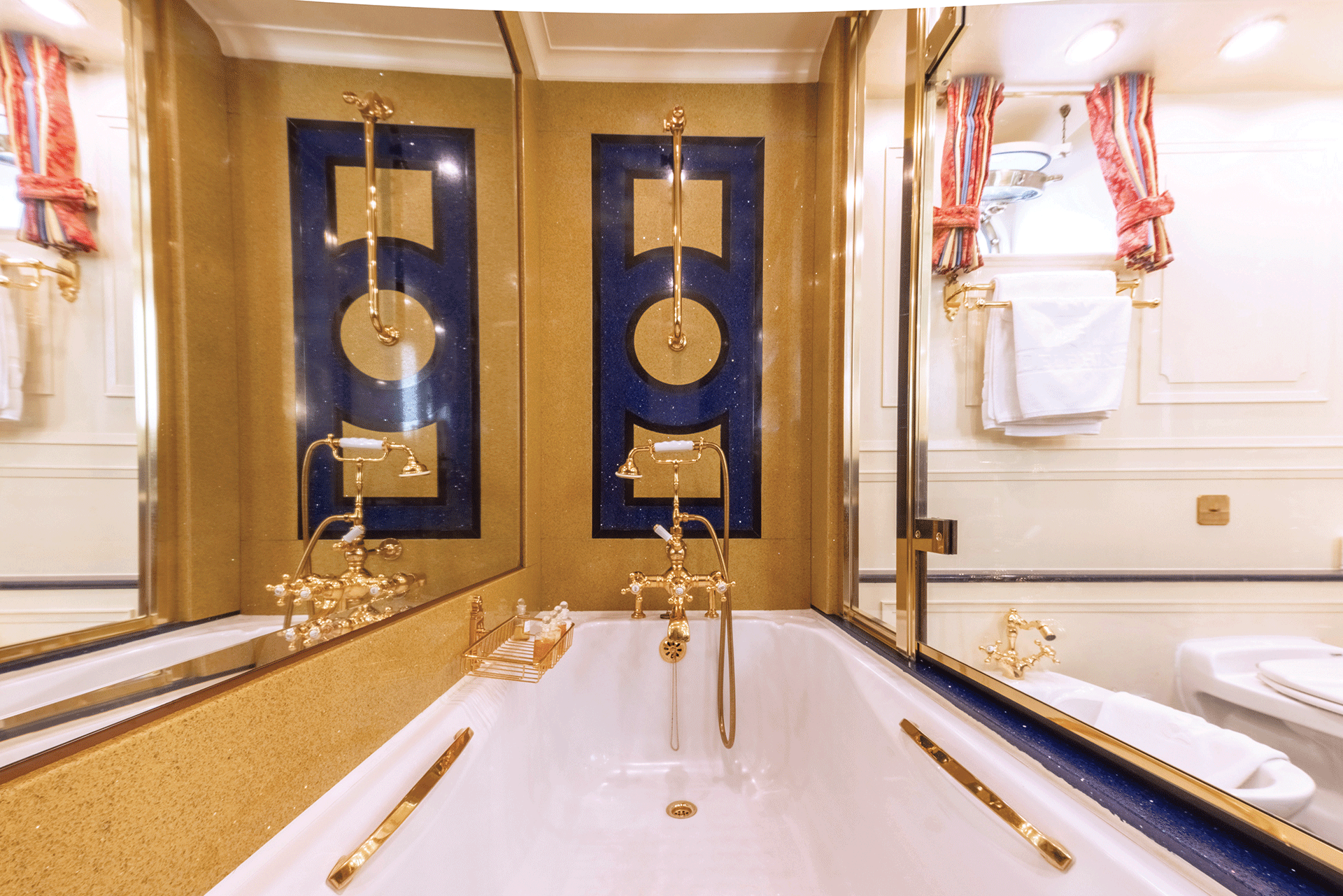
Two full-beam VIP suits lie amidships on the main deck
The main-deck saloon is known as the Music Lounge
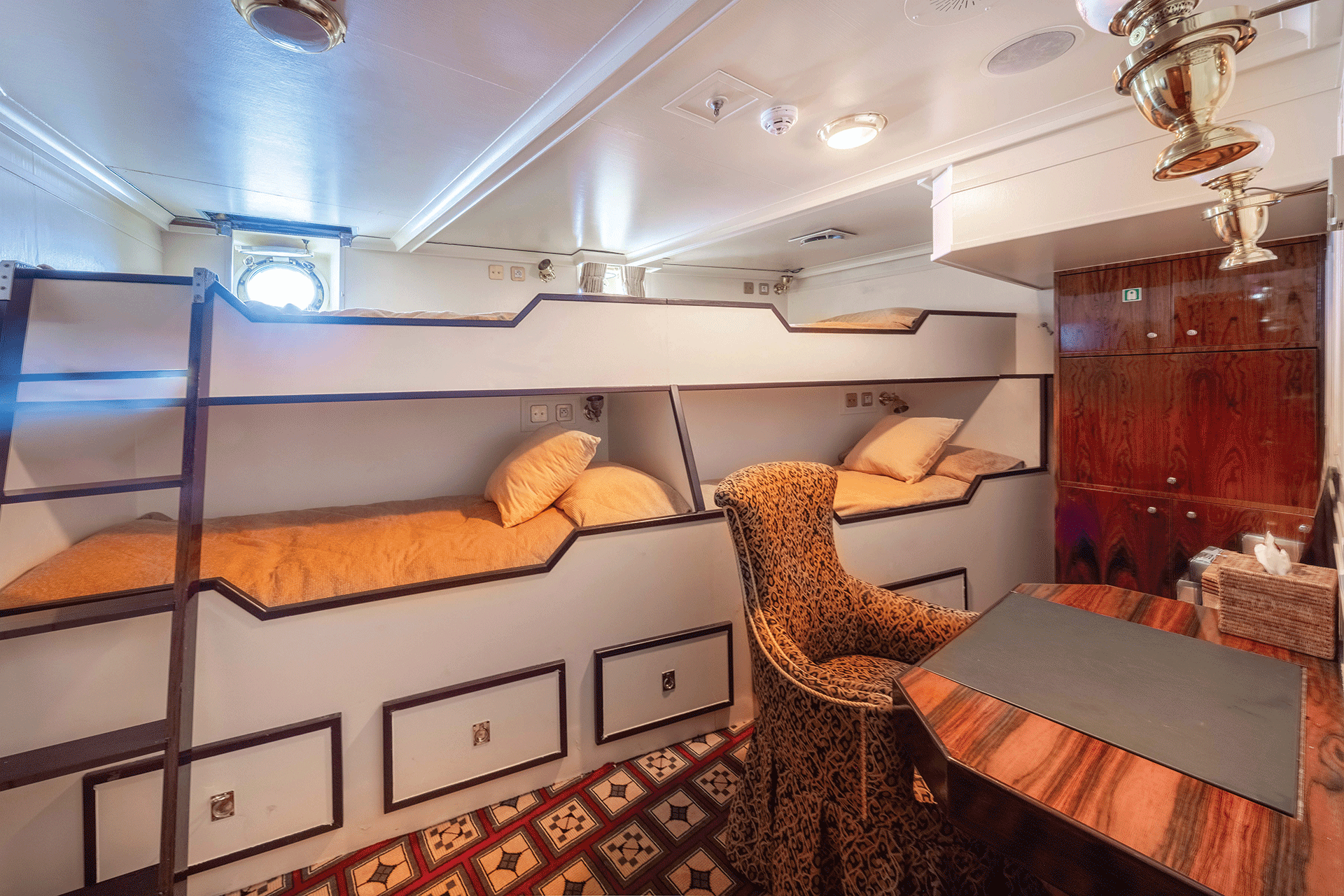
A small cabin with bunks for four children is tucked away aft
The yacht still runs on her original 1921 engine though the boilers were modernised in a 2003 refit
At the bottom of the boat lies a gym and spa with sauna, Turkish bath and spa pool
LOA 78.57m | Freshwater capacity 49,660 litres |
LWL 76.35m | Tenders 6.5m Bombard; 7.5m Colombo Super Indios 24; 7.8m & 11.2m 1943 Custom |
Beam 10.82m | Owners/guests 12 (charter); 26 (private use) |
Draught 6.5m | Crew 26 |
Gross tonnage 1,342GT | Construction |
Engines 2 x steam engines | Refit management |
Generators 2 x 250kW MTU; 1 x John Deere | Refit/Shipyard |
Stabilisers Fixed fins on the original hull | For charter |
Speed (max/cruise) 13/8–10 knots | |
Range at 9 knots 3,000nm | |
Fuel capacity 259,000 litres |