

600 MILES
OF STORIES
Looking back at 120 years of the Newport Bermuda Race

The Newport Bermuda Race, the world’s oldest regularly scheduled sailing competition, has drawn more than 50,000 sailors. Marilyn Mower reveals why
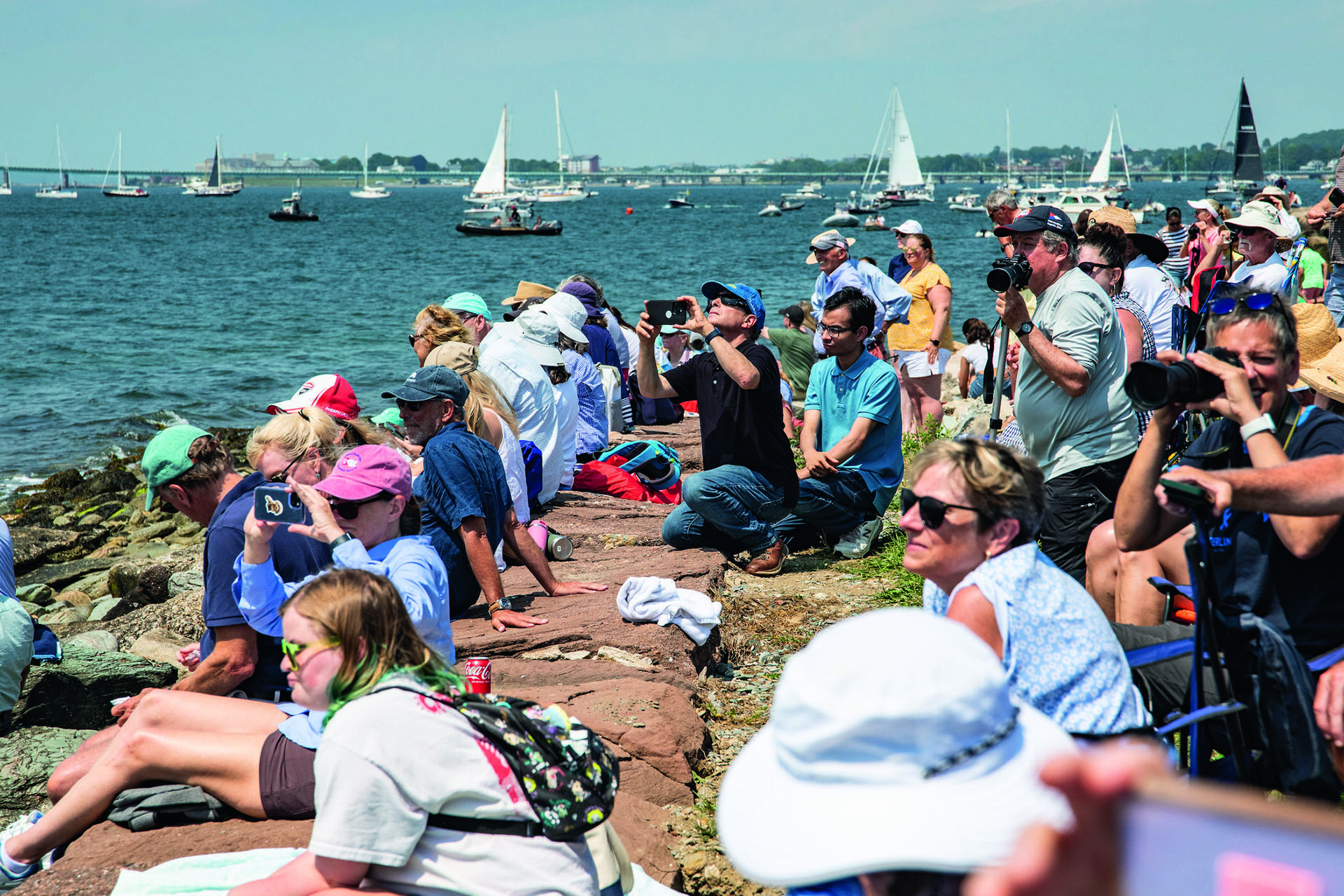
In June of every even-numbered year (this year 19 June 2026), a distinctive fleet gathers in Newport ahead of a biennial race unlike any other. The boats – measuring between 10 and 30 metres long – seem to have little in common: some flaunt twin helm pods, others rely on a simple tiller; there are wooden classics, stock production boats and stripped-out racers.
Within days, an equally eclectic bunch of sailors will leave the safety of Narragansett Bay to slog and slam more than 600 nautical miles to a speck in the Atlantic. From the starting line off Fort Adams, there is one mark off the course and one instruction: “leave Bermuda to starboard as you approach the finish at St David’s light”. How you get there is your business – and that’s the stuff of luck, legend and 120 years of stories told at the bar.
DESIGNED TO BE DIFFERENT
Yacht racing carries with it an air of exclusivity – the newest, the biggest, the fastest and the most high-tech. When the Newport Bermuda Race was founded in 1906 it stood for the complete opposite point of view and honours that spirit still with its Corinthian traditions. During the Gilded Age, ocean racing was the preserve of vast schooners and square-rigged yachts crewed by professionals.

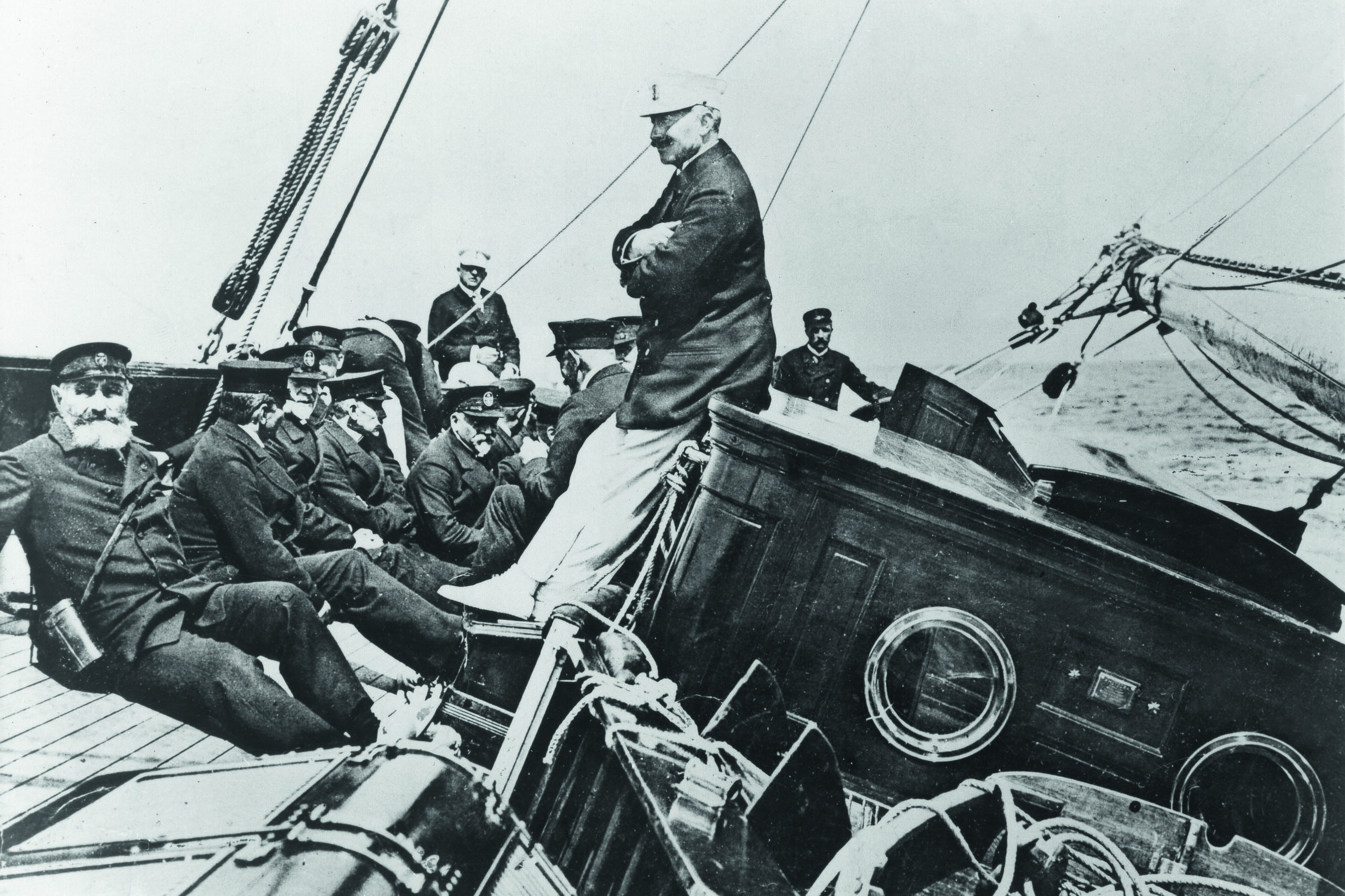
Kaiser Wilhelm II || NICOLA PERSCHEID - HULTON ARCHIVE - GETTY IMAGES
Kaiser Wilhelm II || NICOLA PERSCHEID - HULTON ARCHIVE - GETTY IMAGES
In 1905, Kaiser Wilhelm II of Germany put up a gold cup for a no-limits transatlantic race from New York to the Lizard. Widely publicised and fiercely contested, it was won by the 57-metre three-masted schooner Atlantic, which beat 10 rivals with a remarkable 12-day, four-hour crossing; the Kaiser’s own Hamburg finished 22 hours behind.
DESIGNED TO BE DIFFERENT
Yacht racing carries with it an air of exclusivity – the newest, the biggest, the fastest and the most high-tech. When the Newport Bermuda Race was founded in 1906 it stood for the complete opposite point of view and honours that spirit still with its Corinthian traditions. During the Gilded Age, ocean racing was the preserve of vast schooners and square-rigged yachts crewed by professionals.

In 1905, Kaiser Wilhelm II of Germany put up a gold cup for a no-limits transatlantic race from New York to the Lizard. Widely publicised and fiercely contested, it was won by the 57-metre three-masted schooner Atlantic, which beat 10 rivals with a remarkable 12-day, four-hour crossing; the Kaiser’s own Hamburg finished 22 hours behind.
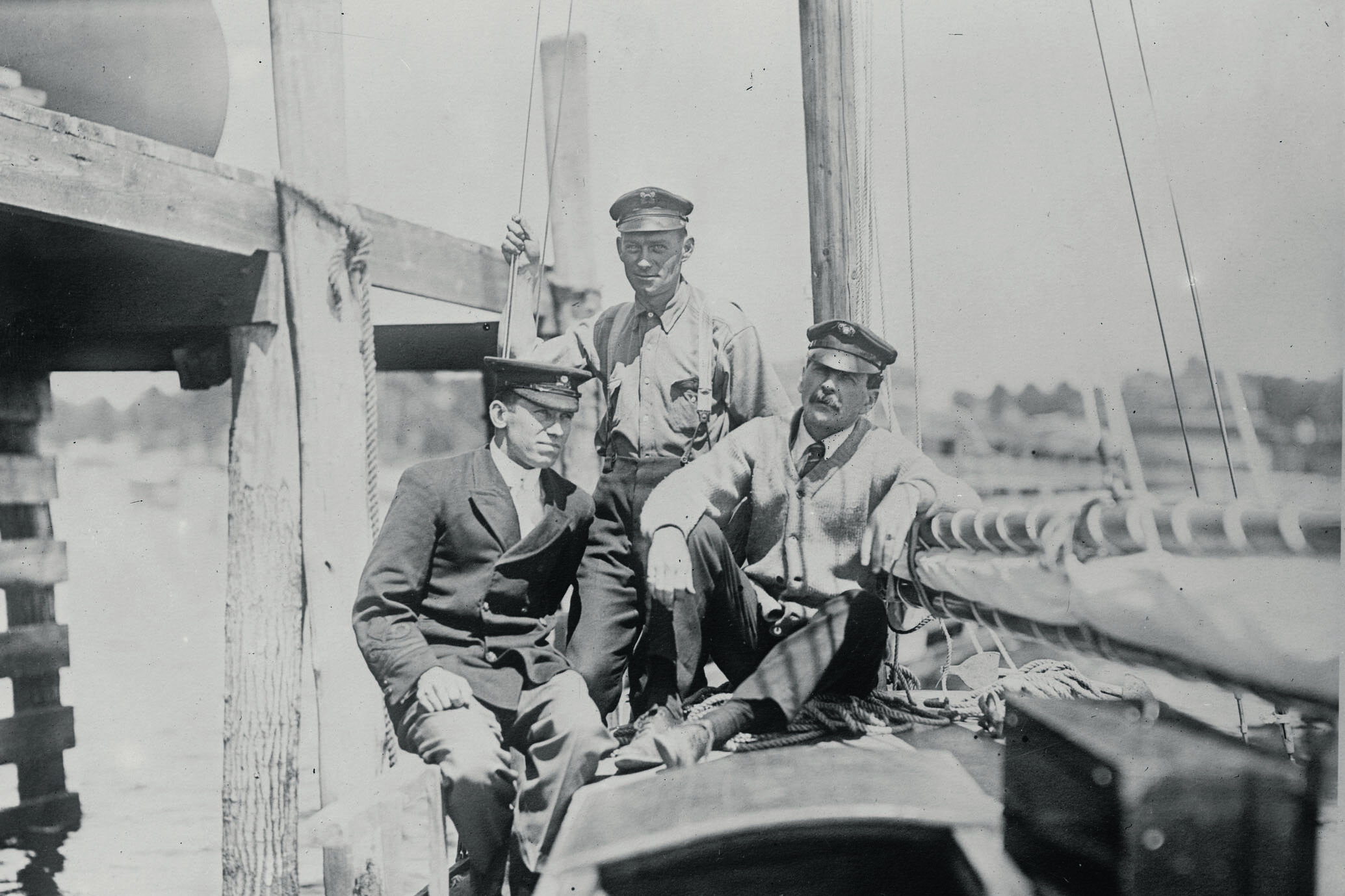
Enter Thomas Fleming Day, a licensed mariner, boat designer and editor of the influential boating magazine The Rudder, who felt the ocean should be everyone’s playground. A man of modest means, Day was a fan of small boats, dinghies and pulling boats who believed sailing small boats taught self-reliance, patience and other skills.

The founder of the Bermuda Race and editor of boating magazine The Rudder was Thomas Fleming Day
The founder of the Bermuda Race and editor of boating magazine The Rudder was Thomas Fleming Day
He also reasoned that sailing boats off-soundings was the logical way to develop better boats and gear. “The danger of the sea for generations has been preached by the ignorant,” he said. Small yachts, he insisted, could sail offshore just as well as large ones if they were wisely designed, properly built and skilfully manned. Large yachts, he said, were too powerful to be sailed by anyone other than trained mariners, turning their owners and guests into bored spectators.
Day enjoyed poking the sailing establishment. He coined names for them: Central Park sailors, armchair admirals, grey-headed, rum-soaked piazza yachtsmen and other more colourful epithets. In 1904, he organised a 330-nautical-mile small boat race from Sandy Hook, New Jersey, around the Nantucket Shoals Lightship to Marblehead, Massachusetts. In 1905 he organised another from Brooklyn, New York, to Hampton Roads, Virginia.

Thora Lund Robinson was at Gaunlet’s helm at the finish of the first race in 1906 ||.
Thora Lund Robinson was at Gaunlet’s helm at the finish of the first race in 1906 ||.
His other races had been coastal events, but in 1906, he convinced two competitors to race him 600 miles to Bermuda. The bigger coup may have been getting the race committee to allow a young woman, Thora Lund Robinson, to accompany her husband as crew aboard his 28-foot sloop, Gauntlet.
People called them fools, but Tamerlane, the 38-foot yawl Day was sailing, and Gauntlet crossed the line off St. David’s Lighthouse to the cheers of 4,000 Bermudians, Thora at the helm. Tamerlane’s winning time was 126 hours and nine minutes.
The next year, 12 boats, including two from Bermuda, entered, validating Day’s idea that amateur sailors in normal boats could sail offshore.

Fleming Day purported that small yachts could sail offshore just as well as large ones, like Atlantic || LIBRARY OF CONGRESS
Fleming Day purported that small yachts could sail offshore just as well as large ones, like Atlantic || LIBRARY OF CONGRESS
NOT A RACE FOR NEWBIES
In the early days, the starting line bounced around from Brooklyn to Montauk to Connecticut. Looking for a permanent partner on the US side, the Cruising Club of America (CCA), an association of distance sailors, stepped up to help organise the race, and since 1936, the start has been Newport, Rhode Island.
In 1958, the fleet grew to 111 boats, and it has not dropped below 100 entrants since, not bad for a race that begins in cold water and can end in simmering heat, with fog, gales and a rollicking wet ride in the Gulf Stream in between. In 1972, participants were tested with the tail of a hurricane.
As if to prove Day’s point, there have only been three sinkings in the race’s history, and just two deaths (sadly, both due to avoidable situations). The race’s strong safety record owes much to the way the CCA runs it. Entry is by invitation, with crews vetted through an Offshore Experience Form reviewed by the Qualifications Committee. Boats are assessed by the Technical Committee for stability and construction.
Despite encouraging Corinthian participation, the Notice of Race is clear: “Not a Race for Novice Sailors”. Mandatory safety training, inspections and strict equipment requirements are backed by rigorous standards – at least 30 per cent of each crew must have completed a World Sailing offshore survival course, while designated crew must hold first aid and CPR certification.

GULF STREAM STRATEGY
Podium finishes in the Newport Bermuda Race depend largely on the skills of the navigator who must combine all forecasts, mix in the yacht’s polar data for its predicted performance at all points of sail, assess the competition and plot the yacht’s fastest course to Bermuda.
After the first day, which is often about getting the boat moving her best in light air, the question is where to enter the Gulf Stream, which can be 30 to 40 miles wide and moving at up to five knots. Here, it is much wider, less organised and less predictable than it is between Florida and Cape Hatteras, North Carolina.
It’s fastest about one-third of the way across. Additionally, warm and cold eddies that spin off unpredictably can help or trap an unsuspecting navigator. For slower boats, picking the best place to cross the stream and locating a friendly clockwise eddy can make or break the race.
Where once the only clues to the location of the Gulf Stream were the ocean’s colour change to deep blue and its warmer temperatures, now the data comes as snapshots from buoys and satellites. In the world of ocean navigators, Stan Honey is the apex predator. He has sailed nearly a million offshore miles and helped secure victories in round-the-world races including the Volvo Ocean Race and the Jules Verne Trophy, when Groupama 3 set a 48-day record.
He has navigated the Newport Bermuda Race 10 times, finishing first on five occasions, and twice helped set race records – one aboard Comanche, which completed the 636-mile course in 34 hours, 42 minutes and 53 seconds. “Even in the best of circumstances, you make decisions based on imperfect data,” he says.

|| GETTY IMAGES
|| GETTY IMAGES
Honey analyses wind and current charts and runs every possible scenario. “You formulate a solution, but you must remain open-minded because you receive new forecast modifications every five hours,” he says. “You have to risk-assess everything. Do you spend miles hunting a favourable eddy? If extra miles sailed have more value than miles saved, you have your answer.”
Honey uses two current models, and although they work off the same data, they don’t always agree. “In 2022, the Gulf Stream models were very different, but when I analysed them, I saw they both included a point that would be favourable midway but only one would be faster. Watching the bearing change on the boats ahead of us as they entered the Stream told me which model seemed right. I picked that model and stuck with it.”

That call probably won them the St David’s Lighthouse Trophy. Of all his Bermuda race successes, that’s the one he is most proud of, the race on his own boat, a vintage Cal40 that he and wife Sally Lindsay Honey, herself a two-time Rolex Yachtswoman of the Year, raced in the Pacific for 33 years. “We finished as the smallest boat in a pack of 60-footers, 12 hours ahead of the next boat in our class,” Honey says.

The 2014 race || DANIEL FORSTER - PPL
The 2014 race || DANIEL FORSTER - PPL
A RACE FOR EVERY BOAT
One reason the Bermuda Race is popular is because it allows owners to choose their style of racing. The Finisterre Division is for boats with no more than 25 per cent professional crew, allowing powered winches but limiting headsail configurations. The St David’s Lighthouse Division features versatile cruiser-racers with manual winches and no more than 30 per cent pro crew; both divisions bar professional helmsmen.
The Gibbs Hill Lighthouse Division is for all-out racers: lightweight, high performance yachts typically sailed by professional crews. Beyond these sit the Open Division for canting keel, water-ballasted or foiling boats, the Super Yacht Division for yachts over 27 metres, the Multihull Division and the Spirit of Tradition Division for replicas and classic designs.
Double-handed racing, where just two people sail the boat, is one of the fastest-growing classes. This year’s Double-Handed Division attracted 16 yachts, including three purpose-built Class 40s. David Southwell, who’ll be double-handing on a J/121 named Alchemy, enjoys the lack of politics and noise that can occur on a fully crewed boat.
He calls the Bermuda Race “the mother of all the offshore races. It’s lots of boats, tons of fun when you arrive, and the regatta is extremely well run,” he says. “The course itself is wonderful – such a strategic race. Four days to Bermuda are more difficult than 21 days across the Atlantic.”

The St David’s Lighthouse Trophy is considered the most prestigious amateur prize in ocean racing || COURTESY NEWPORT BERMUDA RACE
The St David’s Lighthouse Trophy is considered the most prestigious amateur prize in ocean racing || COURTESY NEWPORT BERMUDA RACE
Balancing the need for focus and stamina, this division is the only one that allows an autopilot and power winches for setting and trimming sails. While skills like being able to reef sails alone are essential, “It’s not that hard,” says British naval architect Merfyn Owen, whose day job is designing highlatitude cruising yachts or racers such as Class40s. “But it can be gnarly going at 110-degrees or planning double headsail changes.”
Owen loves the light air section sailing to the west (or north) wall of the Gulf Stream. This year, however, Owen is joining friends aboard Gesture, a classic yacht he says is like “racing furniture. Our goal is the Lighthouse Trophy.” His wife, ice pilot Ashley Perrin crewing on Lively Lady, won the Lighthouse Trophy in 2006 and Owen is out to even the score.

NO PRIZE, JUST STORIES
Whatever your division, Newport Bermuda is not an easy undertaking, and it’s a race with no prize money, just bragging rights. After thrashing your way there, you or another crew (believe it or not, volunteers line up for this) must slog back to the mainland.
So why does the world’s oldest regularly scheduled race continue to attract more than 100 entries a year? “It’s one of the five great ocean races,” says Beau Van Metre, owner of Running Tide, adding that part of the appeal is that it can be done in just a week off work.

Professional sailor Lindsay Gimple in the 2018 race || COURTESY OF THE GIMPLE FAMILY
Professional sailor Lindsay Gimple in the 2018 race || COURTESY OF THE GIMPLE FAMILY
Brad Willauer, president of the Bermuda Race Foundation, who has sailed the race more than 20 times, believes its popularity lies in its purity as one of the few true offshore races.
“The Middle Sea Race, Fastnet and the Caribbean 600 are races where most of the course is near shore. For Newport Bermuda, not only are you out of sight of land for nearly the entire event, for 70 per cent of it you are beyond the range of rescue by helicopter.
“It’s a race requiring strategy, teamwork, self-sufficiency and the highest level of seamanship for three to six days alone on the deep blue sea,” he says. “There’s something satisfying in being able to do that.”
NO PRIZE, JUST STORIES
Whatever your division, Newport Bermuda is not an easy undertaking, and it’s a race with no prize money, just bragging rights. After thrashing your way there, you or another crew (believe it or not, volunteers line up for this) must slog back to the mainland.
So why does the world’s oldest regularly scheduled race continue to attract more than 100 entries a year? “It’s one of the five great ocean races,” says Beau Van Metre, owner of Running Tide, adding that part of the appeal is that it can be done in just a week off work.

Brad Willauer, president of the Bermuda Race Foundation, who has sailed the race more than 20 times, believes its popularity lies in its purity as one of the few true offshore races.
“The Middle Sea Race, Fastnet and the Caribbean 600 are races where most of the course is near shore. For Newport Bermuda, not only are you out of sight of land for nearly the entire event, for 70 per cent of it you are beyond the range of rescue by helicopter.
“It’s a race requiring strategy, teamwork, self-sufficiency and the highest level of seamanship for three to six days alone on the deep blue sea,” he says. “There’s something satisfying in being able to do that.”
“The course is wonderful - such a strategic race. Four days to Bermuda are more difficult than 21 days across the Atlantic”

Another answer is that, despite the mishaps and discomfort, time has a way of reshaping the experience – results are forgotten, and what endures are the stories and the sense of camaraderie. Willauer claims he’s never had a bad experience (a sentiment echoed by many), although he admits there have certainly been memorable moments.
“It was 1958, during the Cold War, and I was on morning watch when a Russian submarine popped up right beside me, a big hammer and sickle clearly visible on the tower” he recalls. “We were a wooden yacht under sail, so we hadn’t been noticed. He was as surprised to see us as I was to see him, and he went down just as fast as he’d popped up!”

Selkie was raced by the late naval architect Jim McCurdy and now by his daughter, Sheila || ROSS SANTY
Selkie was raced by the late naval architect Jim McCurdy and now by his daughter, Sheila || ROSS SANTY
Tori Gimple says that bad times usually involve harsh weather, big seas and something that needs to be managed on a plunging deck at night, like a ripping mainsail.
“But these things are manageable. Our worst experience was in the 2024 Newport Bermuda Race. We were in the Gulf Stream in the middle of the night when we heard a mayday call over the VHF. It was from close friends. They hit something, and it dislodged their rudder, causing massive flooding. They had to abandon ship into the life raft. We sailed to their position, as did another boat, to help with the rescue. Moments like that make you realise how small you are and how big the ocean is.”
Another answer is that, despite the mishaps and discomfort, time has a way of reshaping the experience – results are forgotten, and what endures are the stories and the sense of camaraderie. Willauer claims he’s never had a bad experience (a sentiment echoed by many), although he admits there have certainly been memorable moments.
“It was 1958, during the Cold War, and I was on morning watch when a Russian submarine popped up right beside me, a big hammer and sickle clearly visible on the tower” he recalls. “We were a wooden yacht under sail, so we hadn’t been noticed. He was as surprised to see us as I was to see him, and he went down just as fast as he’d popped up!”

Tori Gimple says that bad times usually involve harsh weather, big seas and something that needs to be managed on a plunging deck at night, like a ripping mainsail.
“But these things are manageable. Our worst experience was in the 2024 Newport Bermuda Race. We were in the Gulf Stream in the middle of the night when we heard a mayday call over the VHF. It was from close friends. They hit something, and it dislodged their rudder, causing massive flooding. They had to abandon ship into the life raft. We sailed to their position, as did another boat, to help with the rescue. Moments like that make you realise how small you are and how big the ocean is.”

Jim McCurdy || COURTESY OF SHEILA MCCURDY
Jim McCurdy || COURTESY OF SHEILA MCCURDY
Sheila McCurdy began sailing to Bermuda with her naval architect father at age 20. She sails now in his boat, Selkie, which turns 40 this year. She calls the Bermuda Race a multi-day extreme sport.
“The last race was 600 miles of beating in large chop. There was a lot of pounding. When you’re at the wheel, the one thing you don’t want to hear from a crew member down below is, ‘Sheila, start the pumps!’ I went below and there was water everywhere in the head. The crew moved her foot, and a geyser shot up through a one-and-a-half-inch [3.8cm] hole where a speed transducer had recently been installed, apparently not very well. She put her foot back over the hole and said, ‘You can fix this, right?’ It really wasn’t an emergency. I carry plugs for every size through-hole in the boat, so she didn’t have to stand there for the rest of the race.”
“It was 1958, during the Cold War, I was on a morning watch when a Russian submarine popped up right beside me”
Yet for all the difficult moments, it is often the quieter memories that endure. “Starry nights with the warm breeze, racing along just in awe of the sky and sparkling bioluminescence going by in the water,” says Gimple. “I love good conversations happening while hiking on the rail, those candid moments when we really get to chat about life, dreams, feelings and next steps. Life offshore is simpler. Sharing that with your best friends is an adventure that creates a deep bond between teammates.”
A sense of achievement is another sentiment echoed by others. Carina’s owner puts it more simply: “Every time we get within 50 nautical miles [of Bermuda], you start to smell frangipani, see the silhouette of the island, the stars seem to come down to the ocean… you almost just want to keep going…”
First published in the August 2026 issue of BOAT International. Get this magazine sent straight to your door, or subscribe and never miss an issue.