

A GODDESS REBORN
Andromeda la Dea: preserving a classic with a major rebuild


A thorough rebuild has retained the bones of Andromeda la Dea while bringing her into the modern era. Risa Merl steps on board the sailing icon
Ifirst saw Andromeda la Dea 30-something years ago,” says the current owner of the 47-metre Perini Navi, launched in 1990. “I contacted Perini and they sent me a brochure – I pored over that brochure like a child reading Superman comic books. Little did I know that one day I’d own her.”
Little did he know, either, that one day he would rescue her from years of disuse, transforming Andromeda la Dea with a new design by Liaigre and a thorough rebuild at Lusben, giving this legendary sailing yacht a new lease of life. Tom Perkins, one of the most boundary-pushing yacht owners of his time, commissioned the Italian shipyard to build Andromeda la Dea, and core to his brief was that she stood out from other sailing yachts on the water.


“Perkins requested the bow to be pulled forward, elongating the profile to give it more grace, and to have a classic heart-shaped stern not seen on any other Perinis,” says Andromeda la Dea’s rebuild captain, David “Hutch” Hutchinson. “He made sure no one else could copy the look.”
Further details that set Andromeda la Dea apart from other Perinis were lowering the superstructure, to give her a more flush, less top-heavy look, and increasing the mast height by a few metres. She quickly became an emblem of a style among super-sized sailing yachts, befitting her name Andromeda – who, in Greek mythology, was a princess known for her beauty and was nearly sacrificed to a sea monster because of it.
Tom Perkins commissioned her, and core to his brief was that she stood out from other sailing yachts on the water


“To say that she holds an important place in the evolution of large sailing yachts would be an understatement – she is the sailing yacht that for many people started it all and essentially put Perini Navi on the map,” says Bruce Brakenhoff, executive director at Edmiston, who has a long-standing relationship with the yacht’s current owner, extending across multiple projects over many years.
“Andromeda la Dea was always an ambassador for large sailing yachts, having participated in the Bucket Regattas, Perini Navi Cups and Millennium Cups, and having circumnavigated the globe.” She was the first Perini, in fact, to complete a circumnavigation, and she’s also sailed the icy waters of both the Arctic and Antarctic.


Moving the steps from the aft deck outboard allowed the cockpit to gain a large dining table || COURTESY OF EDMISTON
Moving the steps from the aft deck outboard allowed the cockpit to gain a large dining table || COURTESY OF EDMISTON
For most of her life, Andromeda la Dea was well maintained, including a major refit at Pendennis in 2010 to 2012. “She was owned and cared for by multiple highly experienced and serious yachtsmen, making her an exceptional candidate for a comprehensive rebuild,” Brakenhoff says.

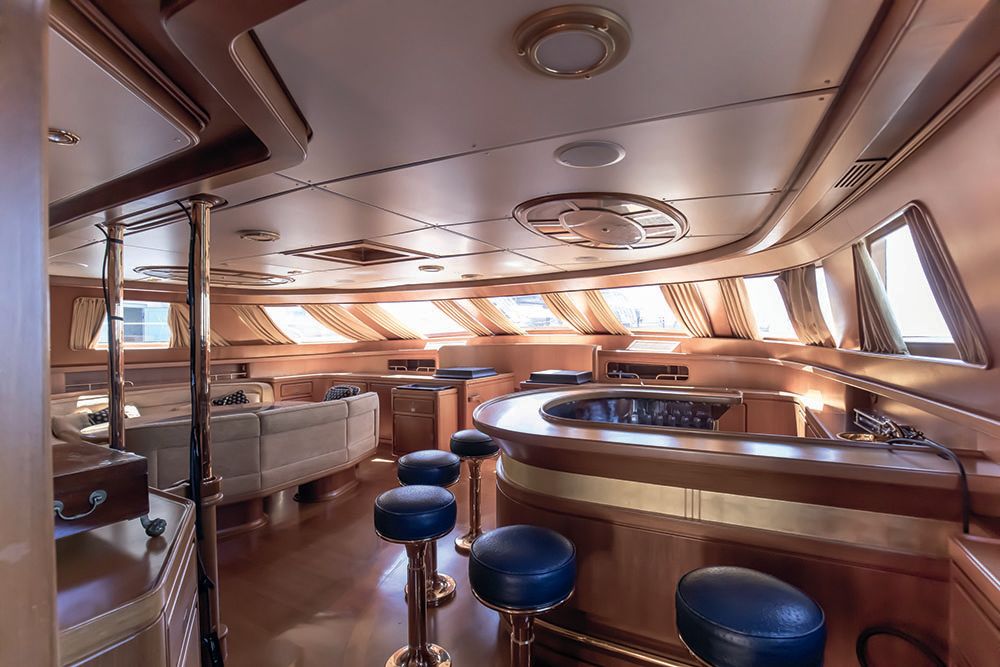
The seldom-used bar, before the re-fit || COURTESY OF EDMISTON
The seldom-used bar, before the re-fit || COURTESY OF EDMISTON
But in more recent times, Andromeda la Dea had been back at Perini for refit work, which coincided with the period when the yard faced bankruptcy and was undergoing a transition in ownership before being purchased by The Italian Sea Group.
The yacht was held in limbo while legal proceedings took place and sat unused for a good few years, right outside the former Perini offices, until her new owner stepped up to the plate and a new refit began in 2022.
It became quickly apparent, however, that this project would not be a refit but a rebuild. “Because of the saltwater, wind and currents, there is no doubt that if you want to keep your boat to a high quality, you have to take her out of the water every year or two and do a lot of work on it; it’s not like a house that can go 50 years without renovation,” says Andromeda la Dea’s owner.
“I’ve done a lot of building in my career and have renovated some gigantic old buildings, including one where all I could save was the façade, and that’s what we’ve done here – we’ve kept the hull and replaced everything else.”


A refit always reveals what lies beneath, and within the first six to nine months of the project, the team discovered just how much work had to be done. “We had a survey, but until you start pulling it apart, you don’t have any idea of the extent of the work you need to do,” says the owner.
“The yacht has been stripped back in a beautiful way that celebrates her joinery and sailing-yacht bones”
In addition to the weather-worn teak decks needing to be removed, the steel supporting the decks was highly corroded. A significant amount of steel work was required, with 70 per cent of the steel decks needing to be replaced.
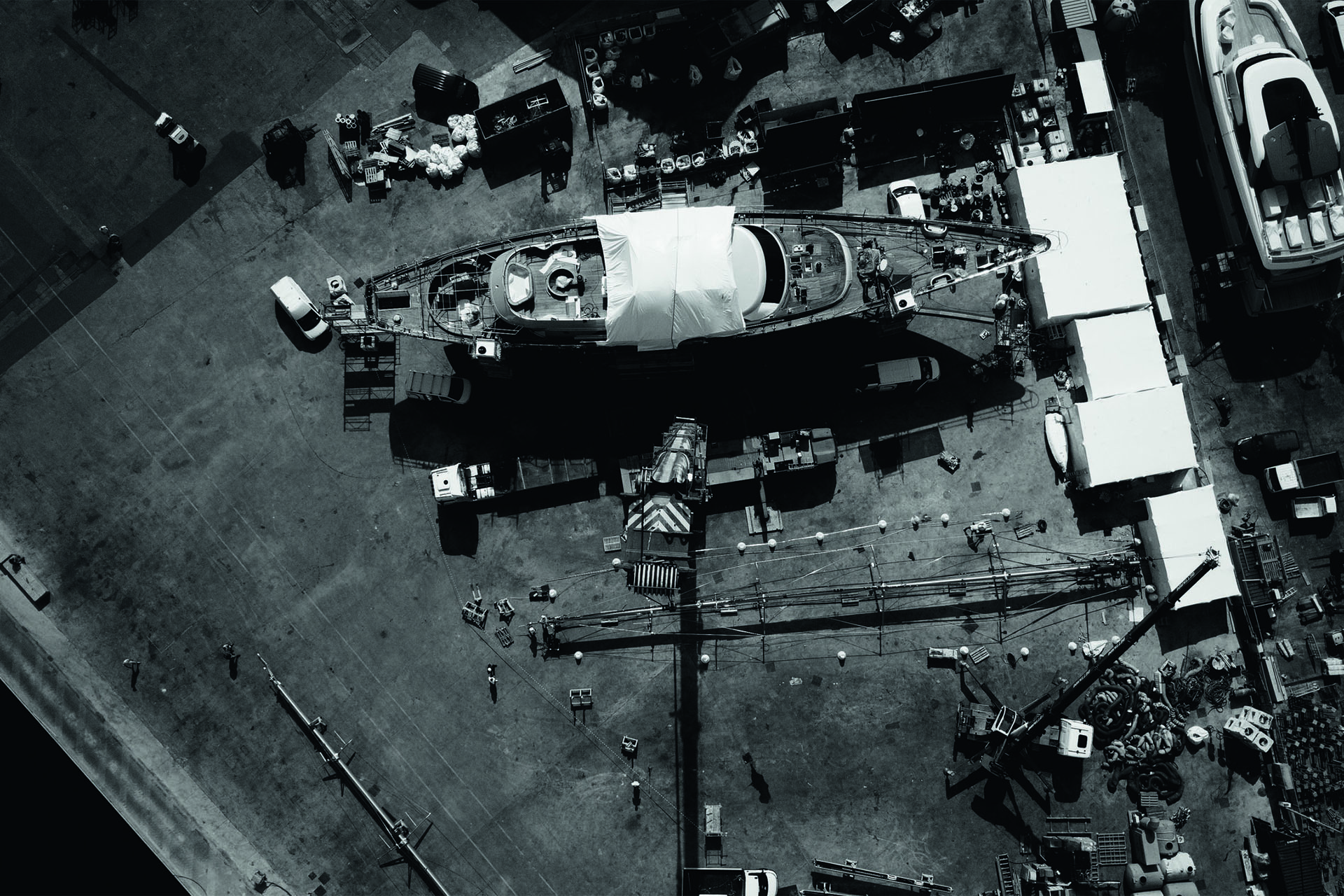
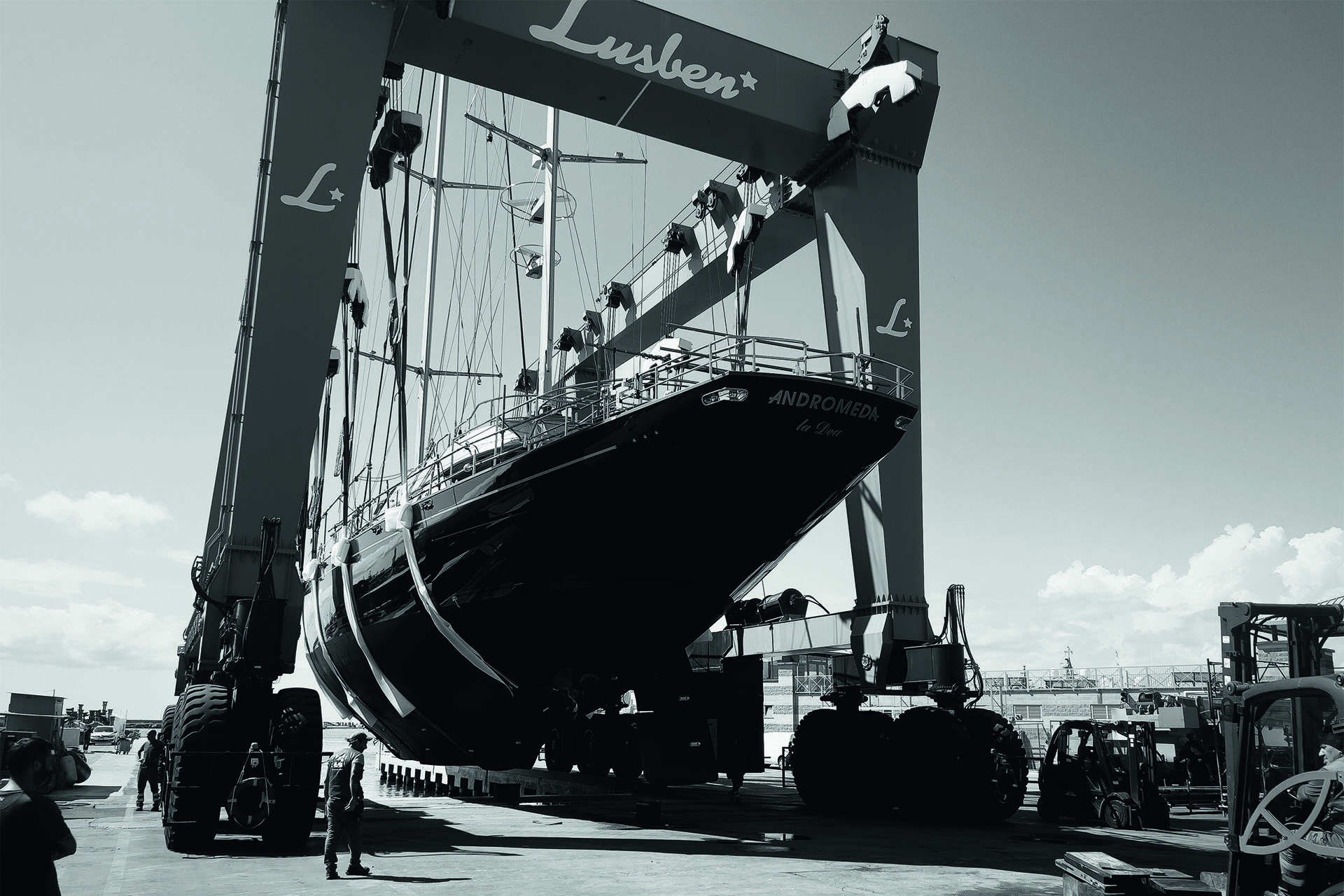
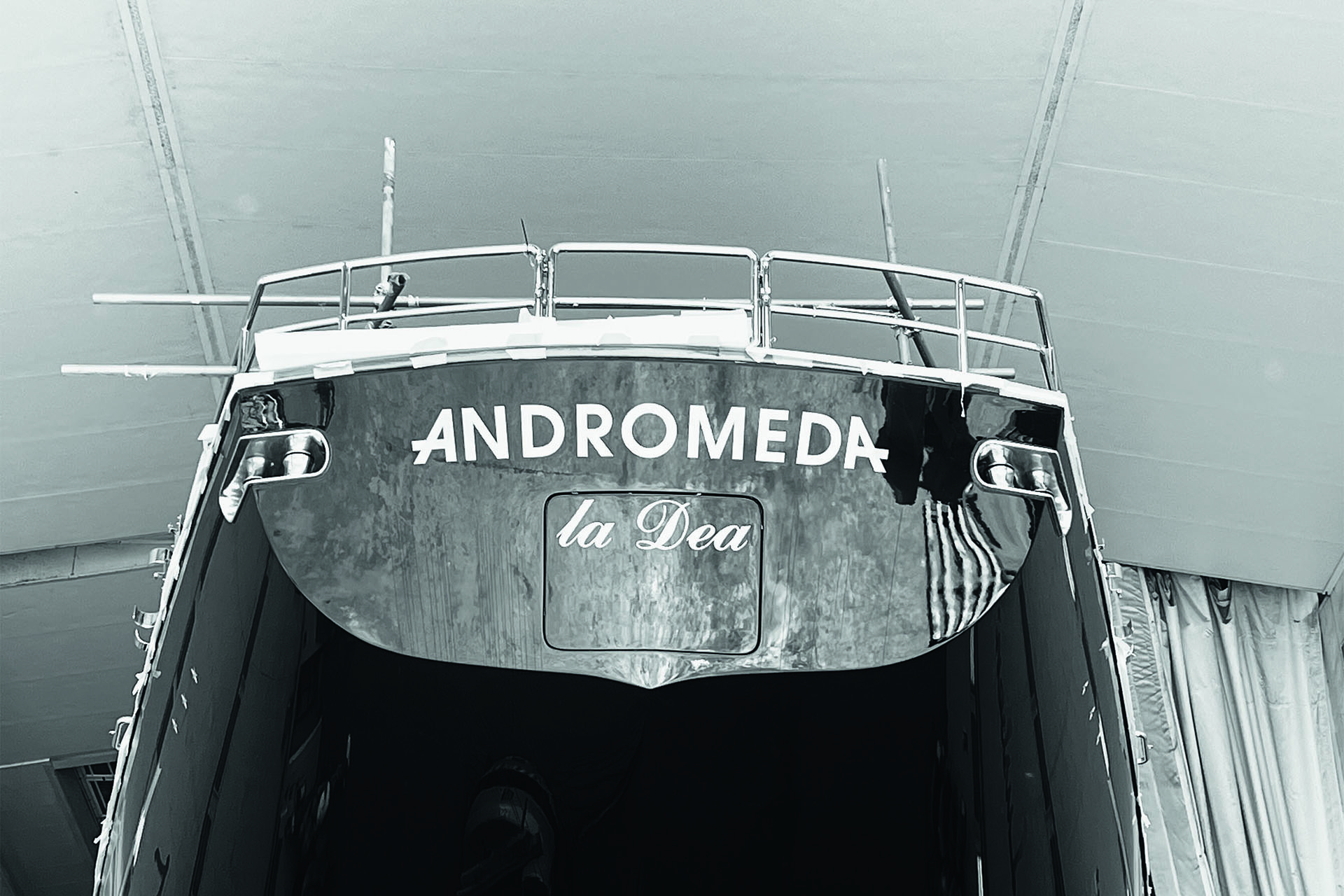
“There was no shortage of ‘surprises’, and they affected various areas of the vessel, with particular critical issues found in the hull structure and the sheet metal,” says Paolo Simoncini, site director of Lusben’s Viareggio and Varazze yards. “These elements required more in-depth analysis and targeted corrective interventions, always with the goal of ensuring full structural reliability and the quality of the final result.”
Fortunately, the aluminium had fared a lot better – the alloy superstructure and its aluminium-to-steel bonding were found to be flawless. “You would’ve expected corrosion, but the superstructure needed very little work,” says Hutchinson as we stand on deck in Viareggio.
As the yacht was already located a stone’s throw away from Lusben, the Azimut-Benetti Group’s refit yard was an obvious choice. Basing the rebuild here also meant that many of the boat’s original build team and suppliers – and their offspring – could be part of the project.

|| COURTESY OF EDMISTON
|| COURTESY OF EDMISTON
We structured this refit with a lot of self-production because we wanted to use the same contractors that built the boat – maybe it’s the sons or the grandsons, but we had the same companies working on the project,” says her captain.
“The teak decks, for instance, are laid traditionally. They’re not patterned; they’re steamed and bent for the planks and wedged into place.” Additionally, Lusben provided the owner’s team with an invaluable resource: project manager Carlo Cinquini, who had overseen the vessel’s original construction.

|| COURTESY OF EDMISTON
|| COURTESY OF EDMISTON
The rebuild sought to retain the exterior styling that made Andromeda la Dea the star that she is, and it was important to the owner to keep the DNA of the yacht, especially in the woodwork.
Hutchinson notes that they purposefully did not touch the cap rail. “The cap rail on this boat doesn’t have any expansion joints; they don’t have craftsmen these days able to make a cap rail like this,” he says of this work of art. Inside, many of the wood mouldings on the ceilings and the floor skirting are also original, as are the curved doors on the lower deck, featuring a basket weave inlay.
We structured this refit with a lot of self-production because we wanted to use the same contractors that built the boat – maybe it’s the sons or the grandsons, but we had the same companies working on the project,” says her captain.
“The teak decks, for instance, are laid traditionally. They’re not patterned; they’re steamed and bent for the planks and wedged into place.” Additionally, Lusben provided the owner’s team with an invaluable resource: project manager Carlo Cinquini, who had overseen the vessel’s original construction.


The rebuild sought to retain the exterior styling that made Andromeda la Dea the star that she is, and it was important to the owner to keep the DNA of the yacht, especially in the woodwork.
Hutchinson notes that they purposefully did not touch the cap rail. “The cap rail on this boat doesn’t have any expansion joints; they don’t have craftsmen these days able to make a cap rail like this,” he says of this work of art.
Inside, many of the wood mouldings on the ceilings and the floor skirting are also original, as are the curved doors on the lower deck, featuring a basket weave inlay.
“She is the sailing yacht that essentially put Perini Navi on the map”


One subtle but highly functional change to the exterior came in the form of the cockpit entrances. Previously, there was a single set of steps leading from the aft deck that cut through the centre of the cockpit, dividing the dining table in two.
Guillaume Rolland, principal of Liaigre, revised the layout to create two entryways on either side of the cockpit, and closed the entrance at stern, which allowed for one large table to be placed aft, affording a more convivial al fresco dining experience.
The most noticeable differences, however, come when you step inside. Barring some of the woodwork that was retained, “everything has been stripped out and rebuilt,” says Hutchinson.
Previous refits on Andromeda la Dea were very different in style, with gold fittings, marble sinks and seahorse taps being added to the boat. “It suited the period, but it maximalised her – with Liaigre, you are kind of bringing her back,” he adds.


In the engine room, the Caterpillar mains were rebuilt and zeroed out || COURTESY OF EDMISTON
In the engine room, the Caterpillar mains were rebuilt and zeroed out || COURTESY OF EDMISTON
Indeed, as to be expected of Liaigre’s minimalist, organic but never boring style, the yacht has been stripped back in a beautiful way that celebrates her joinery and sailing yacht bones while re-inventing the layout and adding to her functionality.
“Until you start pulling it apart, you don’t have any idea of the extent of the work”
The owner had previously collaborated on projects with Liaigre. The brief for this project started with, “questioning the right philosophy to approach this iconic yacht,” says Rolland.
“The key strategy was to make a restoration rather than a tabula rasa refit, erasing some heavy and outdated features and preserving the original decor and teak panelling, to preserve the soul and the good vibes of the yacht.”
The original teak panelling anchors the background of the interior, with accents of dark-stained, brushed oak to create contrast. “This brings a discreet touch of modernity without fighting with the existing decor,” says Rolland, who revised the furniture arrangement to improve flow and maximise space efficiency.
This involved creating custom-designed furniture pieces that fit with extremely precise shapes and proportions, working with the unique space constraints of a sailing yacht.
This precision is well illustrated on the forward main deck. Previously, there had been a dining area to port and a bar to starboard. The entire space has been reimagined and maximised, moving the dining to starboard and removing the bar. In the owner’s experience, an inside bar is often redundant. “People want to be outside, even at night,” he says.
With the bar gone, there was room to add a VIP cabin with a double bed to port. An on-deck cabin has proven to be a valuable feature on other large sailing yachts, as Hutchinson highlights.
“It’s incredibly beneficial for two main reasons: first, it eliminates the challenge of navigating steep stairs for older [or physically impaired] guests, and second, it offers greater flexibility for charters,” he explains. The en-suite deck cabin is separated from the dining area by a sliding door with PrivaGlass technology.
“The key strategy was to make a restoration... to preserve the soul and good vibes of the yacht”
The rebuild also managed to add a new bunk cabin on the lower deck, replacing an owner’s study. “I wasn’t sure it would work,” Hutchinson admits as he shows me the bunk cabin. “But it’s actually one of my favourite little spaces on board. It’s one of those Guillaume things that’s a very clever use of space.”
Unlike traditional bunks stacked on top of one another, the heads of bunks are pointing away from each other, with the upper bunk suspended in the air, the foot of the bed stopping before reaching the wall.


This means the upper bunk has plenty of privacy and light from the porthole, while the lower bunk has headroom so someone can sit up in bed reading. This additional cabin stretches Andromeda la Dea’s accommodation to four guest cabins down below, plus the full-beam lowerdeck master, and the main-deck VIP up top.
The existing cabins and master have all been redesigned and modernised, including adding a Japanese-style bathtub in one of the guest cabins, ideal for bathing children.
As for Rolland’s favourite space on board, it’s outside – the bench set along the coaming in the redesigned aft cockpit. “It’s the sweet spot leeward when you are sailing upwind – best place to feel the power of the yacht sailing,” says the designer. And one thing you’ll certainty feel, if lucky enough to sail on Andromeda la Dea, is her immense power.

|| COURTESY OF EDMISTON
|| COURTESY OF EDMISTON
Much more than skin deep, the rebuild also included modifications that focused on integrating new, low-impact technologies, with a particular focus on optimising structural weight. “This approach made it possible not only to comply with the latest environmental standards, but also to preserve and improve the vessel’s original performance,” says Simoncini.
The rebuild managed to add a new bunk cabin on the lower deck, replacing an owner’s study
As Hutchinson notes, Andromeda la Dea has a very fine forward entry and a V-shaped forefoot, so she doesn’t slam like a lot of the bows on more modern sailing yachts, and because she has a high flare on the bow, she lifts quite quickly.
“She’s from an older generation of classic-style boats, where she’ll sail just about everywhere at about an 18-degree heel angle,” Hutchinson says. “Her stability comes in later than a modern boat, but she stiffens right up and, unlike some of the modern boats, she’s quite fine aft, so she doesn’t get picked up by waves and rolled.”
Her sailing prowess is now aided by a full wardrobe of North Sails 3Di sails, and she has new Harken genoa captive winches, hydraulic carbon in-boom furling and Nirvana spars. Her rig was worked on by BSI Rigging in Denmark, and she has rod rigging serviced through 2030.
One of the things that both the owner and captain were completely sold on keeping was the fisherman staysail. “While it’s a sail that most modern sailors wouldn’t embrace, I can tell you from history that having a fisherman when you’re underway helps to stabilise the boat,” says Hutchinson.


Whether the owner – who poured so much time, energy and investment into reviving Andromeda la Dea – will get to experience her in a regatta remains to be seen.
During the course of the project, he had the chance to buy back one of his previous, larger yachts, and Andromeda la Dea went on the market with Bruce Brakenhoff at Edmiston, giving a prospective buyer the chance to have a like-new Perini Navi without waiting three years.
“I went back to another boat I loved,” says the owner. Despite the challenges of such a thorough rebuild, the owner seems to have enjoyed the process. “It was fascinating and great fun. Now we’ve done all the work, and someone else is going to get to enjoy it.”
First published in the April 2026 issue of BOAT International. Get this magazine sent straight to your door, or subscribe and never miss an issue.


A custom spa tub and new furniture enhance the flybridge
An underwater bow camera, dubbed the 'Dolphin Cam', has been added
Removing an interior bar made space for an on-deck VIP cabin
The passageway hosts a guest pantry with a coffee machine for guests to help themselves
A large convivial dining table at the stern is a new addition
The owner's cabin is full beam with his-and-hers en suites
LOA 47m |
|
LWL 34.7m | Freshwater capacity 11,400 litres |
Beam 9.2m | Tenders 1 X 5.7m William Dieseljet 565; 1 X 4M Zodiac Milpo |
Draught 3.6m | Owners/guests 12 |
Gross tonnage 304GT | Crew 6 |
Engines 2 x Caterpillar C18 | Construction |
Generators 2 x 90KW Northern Lights | Classification ABC, MCA |
Speed under power (max/cruise) 14/12 knots | Naval architecture Perini Navi |
Range at 9 knots 5,000 nm | Exterior design Perini Navi |
Main and Mizzen Masts Nirvana | interior design Liaigre |
Rigging Navtec | Builder/Year Perini Navi/1990 |
Sail area 1,000 m2 | Rebuild shipyard/year Lusben/2025 Viareggio, Italy |
Sails | For sale edmiston.com |
Winches Harken |
 Built with Shorthand