

GAME
CHANGER
Rethinking the guest/crew divide on Oceanco's Leviathan

Each shipyard has its own personality. Oceanco, in Alblasserdam, the Netherlands, feels like a secure, high-tech facility where innovations are hatched in a clinically clean and climate-controlled environment. The headquarters have a state-of-the-art geothermal-heated drydock, from where the new 111-metre Leviathan emerged.
However, it wasn’t that aspect alone that attracted the shipyard’s new owner to this cutting-edge builder – an owner who turned a yacht project known as Y722 into Leviathan and also repurposed Oceanco’s first yacht built to the former Passenger Yacht Code into a support vessel named Draak. What prompted Gabe Newell to make a bid for the yard last year, in addition to building and refitting two yachts there, were the people.
“When you are building the vessel with Marcel [Onkenhout, Oceanco’s CEO] and his team, it feels very much like you are collaborating to achieve a set of shared goals,” Gabe Newell said during a virtual interview at the 2025 Monaco Yacht Show. “Just the way Marcel works sort of makes it feel like you are part of his organisation,” he said. He added with characteristic humour, “We went on a date and then we decided to get married.”

The acquisition was announced in August 2025. A few months later, Leviathan, which was in the last phase of construction, left the Netherlands for new horizons, reaching the Canary Islands in late November on her way to the Caribbean.
Newell went from building a popular videogame platform and applications – that earned him uncommon reverence in gaming circles as co-founder of Valve – to research in neuroscience via Starfish and ocean exploration via Inkfish, an institution he sees as a service organisation for scientists. A renaissance man for the computer age, he is interested in a vast range of topics, including AI, developing an aerosol pathogen-detection system, machine tooling, which he got into as a hobby, and diving.
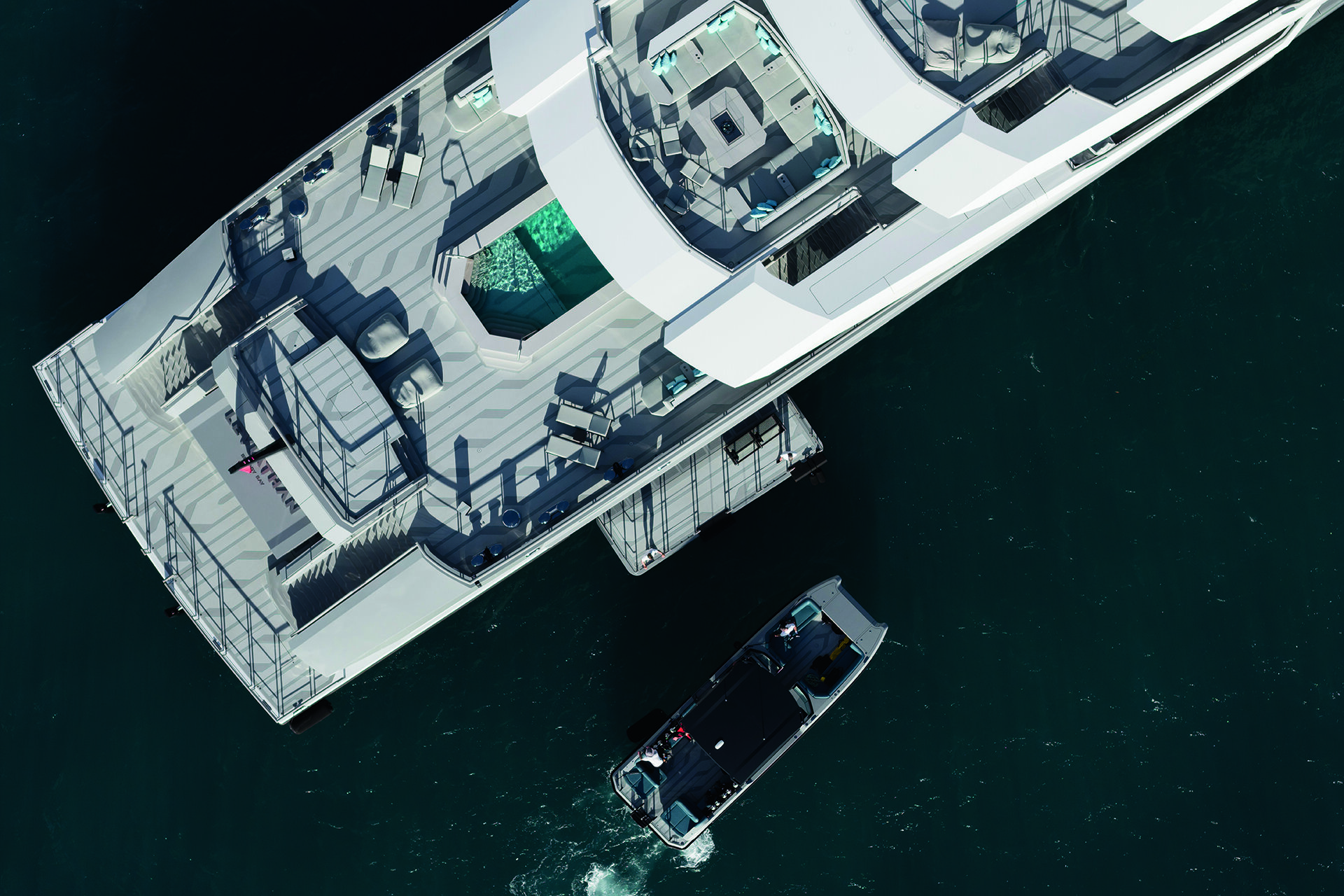
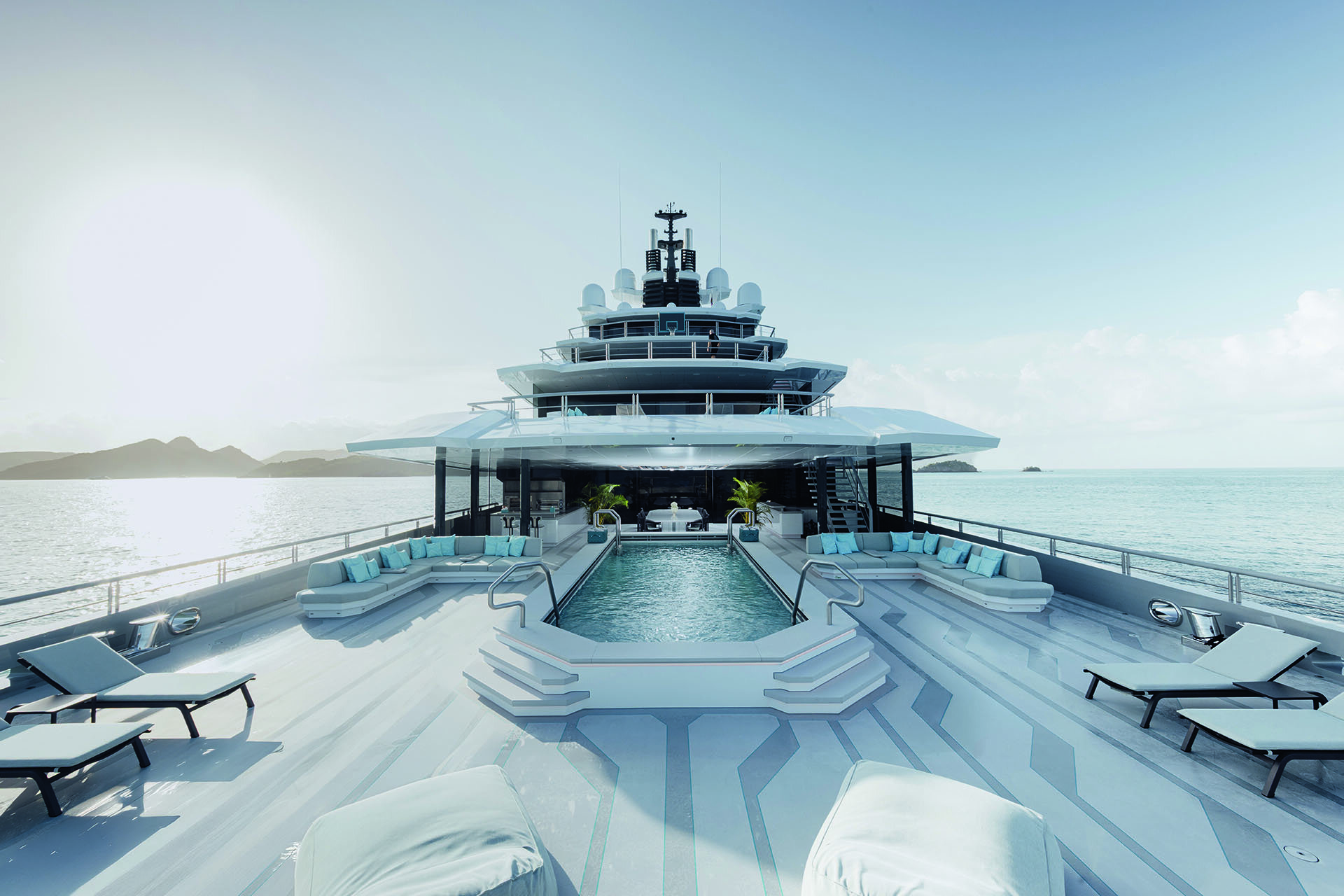
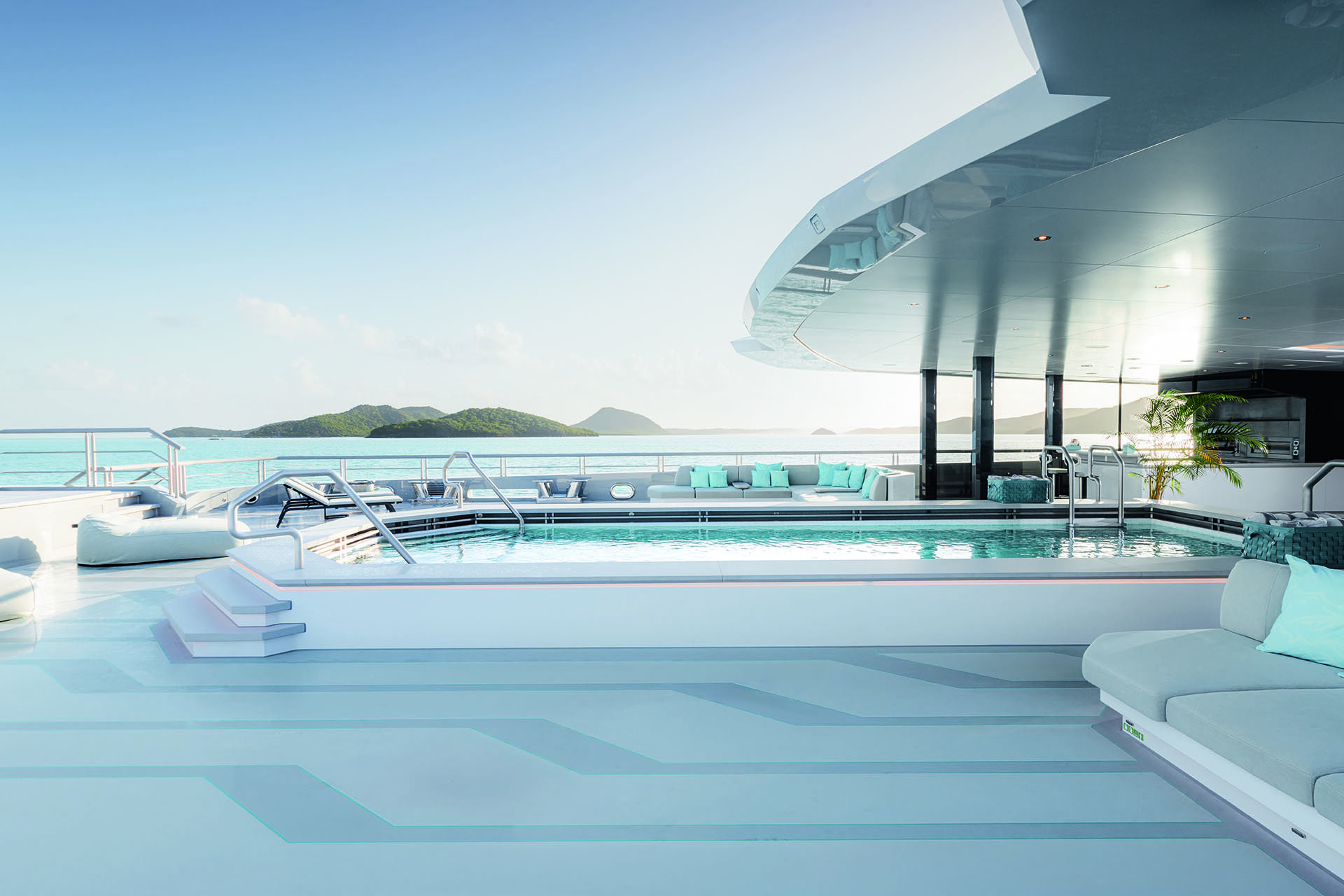
The yacht, designed by Oceanco’s in-house team (which also designed Y709, now Draak) is handsome and well-built, as an extensive walkthrough in the late stages of construction revealed, but one of Leviathan’s more intriguing aspects is that it upends yacht design conventions, particularly in the allocation of guest and crew spaces, and it also serves the dual purposes of high-end hospitality and research laboratory.
“The technical origins of Leviathan sit within development of Lateral’s DE-Series hull family, conceived to take full advantage of dieselelectric pod propulsion,” explains Lee Archer, principal project manager at Lateral Naval Architects.
“At that time, it represented a very forward-looking engineering platform – propulsion integration, structural stiffness, roll period, electrical architecture. Comfort and efficiency were designed from first principle, not mitigated later. What’s interesting is how that platform then evolved. The naval architecture and propulsion concept created a flexible technical foundation, which allowed the owner and project team to rethink how the yacht itself could be arranged and used.”
“It may be a slightly idiosyncratic perspective as an owner, but we wanted to take a crew-centric approach”

The project evolved significantly, but very gradually in a collaborative process that asked questions along the lines of “Why does it have to be that way?” This approach was one of the project’s most interesting aspects. “It isn’t just about what changed on board the boat. It’s [about] the cultural shift,” says Archer. “Suddenly you find yourself questioning the entire approach to delivering a project, but in a very constructive way.” He says it gave a better result. “Technically, everything is robust and well resolved.”

|| GUILLAUME PLISSON
|| GUILLAUME PLISSON

|| GUILLAUME PLISSON
|| GUILLAUME PLISSON

|| GUILLAUME PLISSON
|| GUILLAUME PLISSON
Newell attributes his way of thinking to his early days as part of the small development team on Windows 1.0. “There were 13 of us. We all had to wear a bunch of hats,” he says. When he arrived into the yachting world, he asked a lot of questions but slowly moved away from relying exclusively on outside experts and hierarchy towards involving the crew in the decision-making.
He first tried that idea with the design of a new tender, with the help of the dive crew, and it proved successful. “The more the crew is involved in the design of the spaces they are operating in, the better the outcome,” Newell maintains.
He currently has a small fleet at his disposal between research and support vessels and private yachts (the Lürssen Rocinante, the first yacht he acquired, recently joined the sales market), so there are many crew members to weigh in. Operationally, how this translates on Leviathan is that the line between guest and crew spaces is blurred.
Portions of two decks, usually reserved for the yacht’s owners and guests, have room for the crew to recreate – a basketball hoop on the bridge deck (just aft of a large U-shaped games room) and space for a regulation beer pong table and a spa pool on the sundeck.
The yacht will be able to accommodate 12 guests and up to 43 crew and so the main deck includes a communal dining area for up to 56 – rather than the usual formal dining space, just beyond the large pool and exterior dining table, which is large and close enough to double as a launching platform for the pool.
The interior dining arrangement located on the main deck “is designed as a communal space for both guests and crew, with a large buffet and pantry linked to the galley”, explains Bas Swanink, Oceanco’s sales director, as we walk into the space and I give him a quizzical look.
The huge galley itself, organised in specialised stations for plating, cleaning, pastry making, etcetera, is not just for cooking. “It will be used for training other chefs,” Swanink says. Improving skills is another important part of Newell’s philosophy. “There are real benefits to building a team with the highest possible level of skill,” adds Newell.
“Among the uncommon requests the owner had for Leviathan was to have no teak on board”

The former beach club, designed as a large and relaxing space for the yacht’s original commissioning owner by Mark Berryman Design, has become a combination of relaxation and working area, which includes a lab with a 3D printer and extensive diving facilities.
Newell, who came to yachting following experiences with charter that made him a believer, spends a large amount of time aboard his yachts. They are his homes, his research laboratory, his platform for exploring the deep.
Designer Mark Berryman replaced the sycamore and wenge with stained European oak for warmth, consistency and durability
Among Newell’s uncommon requests for Leviathan was to have no teak on board. The search for a solution led Oceanco to Dutch flooring specialist Bolidt, which developed and installed a patterned artificial deck for the yacht in two tones of grey. The custom designed patterns on the decks repeat the sculptural features of the superstructure.

[[Leviathan]] has the spirit of an explorer with a chiselled superstructure on top of a beamy hull that conceals a large garage for two 11m tenders || GUILLAUME PLISSON
[[Leviathan]] has the spirit of an explorer with a chiselled superstructure on top of a beamy hull that conceals a large garage for two 11m tenders || GUILLAUME PLISSON
Research and development allowed for minimising the heat load on the material and gave it its distinct patterns, “a design that is entirely unique both in pattern and performance”, according to Robert van Aarle, director of Bolidt Maritime & Defence. The caprails are also made with a synthetic product. The choice of synthetics is as much about low maintenance as it is about environmental compliance.
“It may be a slightly idiosyncratic perspective as an owner, but we wanted to take a crew-centric approach,” Newell says, “By improving crew productivity, they have more time to focus on higher-value activities. After all, what’s more important, having a crew member taking a guest on a jet ski or polishing chrome?” For him, the obvious answer is the crew is best employed to provide the experience.
“The project evolved in a collaborative process that asked questions along the lines of “why does it have to be that way?”

And so naturally, the same idea applies inside. Berryman, who had done the original concept for the previous owner as an art deco interior (except in the beach club), had to return to the drawing board within the constraints of time and materials already ordered.
Working with outfitter Vedder, he replaced the sycamore originally specified as an accent material and the wenge (which tends to lose its colour with time) with stained European oak and brushed oak for warmth, consistency and durability.
The designer worked with the owner and the crew. “What was really interesting was how important the crew are to him,” Berryman says. “There isn’t this hierarchy or this separation between crew and guests.”
For the experienced designer this approach from an owner was a first – and surprising. “This is prime real estate, are you sure?” Berryman recalls asking, when prompted to transform the lovely saloon/dining arrangement on the main deck he had originally devised for the previous client into a crew mess.
Another unusual request dealt with a high-tech games room that replaced the traditional upper deck saloon. “We designed the games table,” Berryman says, and then he collaborated with the owner’s IT specialists to integrate equipment that includes ceiling cameras and a projector for holograms and virtual reality. The table is surrounded by a fleet of gaming chairs.
“It’s absolutely fantastic,” Berryman says. Effectively, the yacht has no formal saloons as we have seen them on virtually all superyachts to date. Worth mentioning as an uncommon space on a yacht (even if not one totally unheard of) is a perfectly soundproofed room on the bottom deck, large enough to contain a drum set and used for sound and video editing.
Yet another unusual touch is that two computer stations flank the spa/massage space on the sundeck, which is accessible via the guest lift that connects five decks.
One of the primary requests had been about noise and vibration damping inside. It became “one of the most ambitious goals” for a yacht of this kind
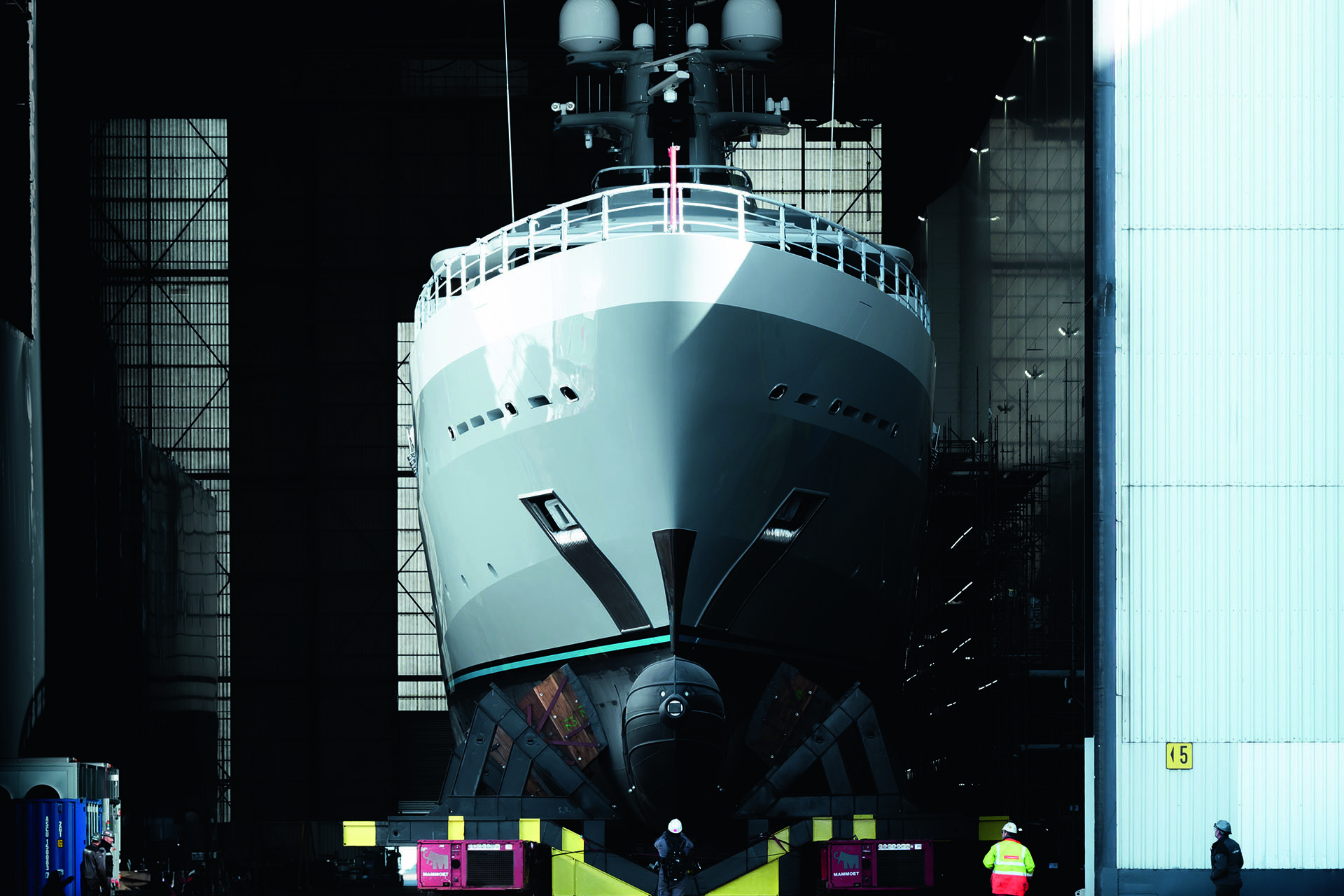
On the exterior, the yacht is elegant, sculptural and slim in appearance despite a volume approaching 5,000GT. It has, as Vernhet describes it, “a striking forward-leaning silhouette with strong prismatic forms”. The aim was also for a masculine and strong look.
Due to the 17.8-metre beam, a lot of volume is in the hull, which means the superstructure remains relatively compact, helping with the overall elegance. It is more of an explorer concept, with the bulk of the superstructure positioned forward to balance the spacious aft deck with its 10-metre pool, Vernhet says.
The hull colour changed, from white to a more maintenance-friendly “medium grey” to go along the Matterhorn White superstructure.
Leviathan is elegant, sculptural and slim in appearance - “a striking forward-leaning silhouette with strong prismatic forms”

Within that superstructure, Oceanco maximised windows, including on the lower deck where six guest cabins are located (four VIP cabins, two with balconies, are on the upper deck, as is the owner’s suite). Glass is a feature – although not producing the effect of a glass box. The largest panes, supplied by Tilse, weigh 1,400 kilograms each. They are tinted, insulated and contain heating elements for the bridge.
The builder maximised the ceiling height (up to 2.8 metres), which, in combination with the glass, opens the yacht to the natural light. Beyond this, one of the primary requests had been about noise and vibration damping inside, says Oceanco senior yacht designer Patrick Casanova, calling it “one of the most ambitious goals” for a yacht of this kind.
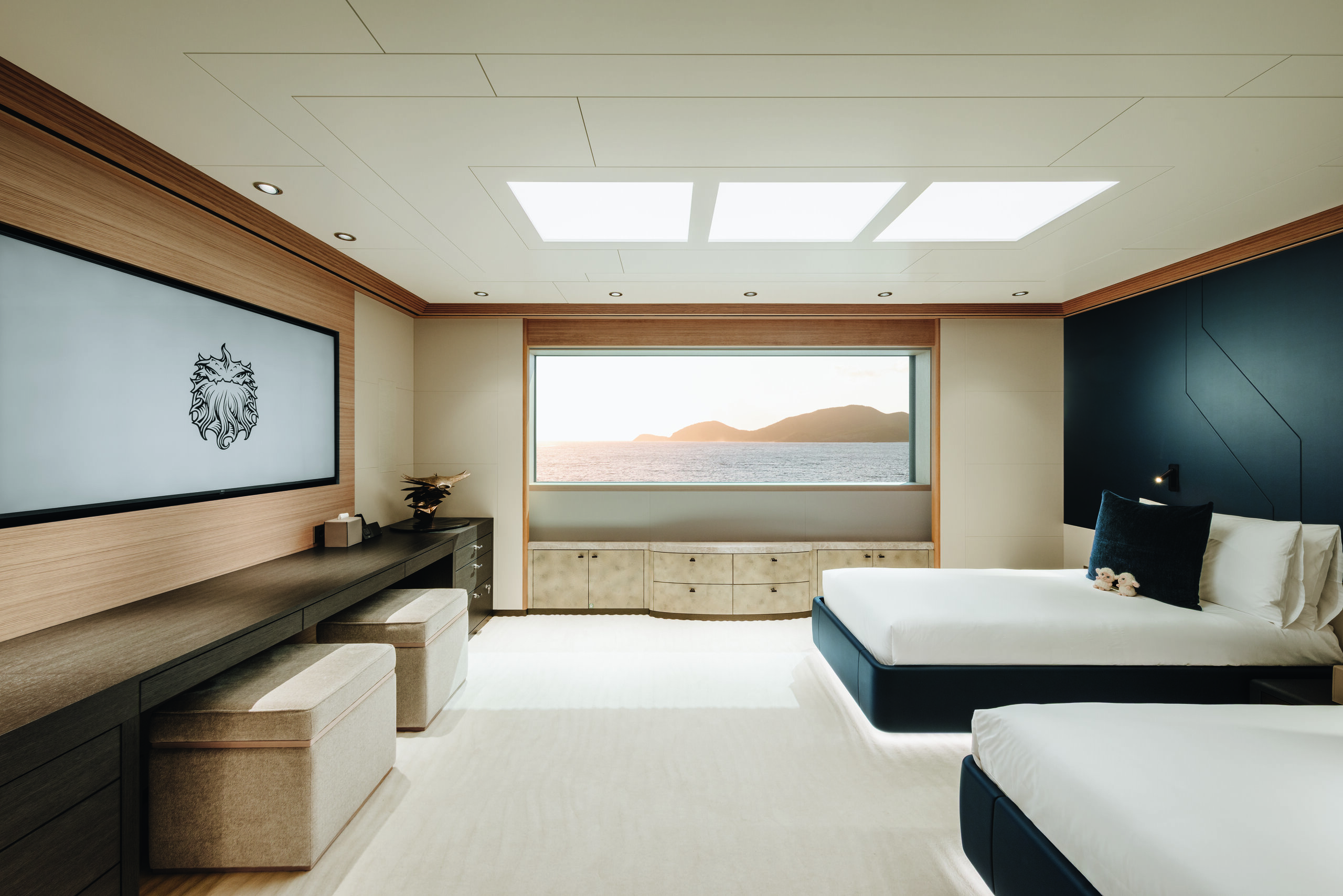
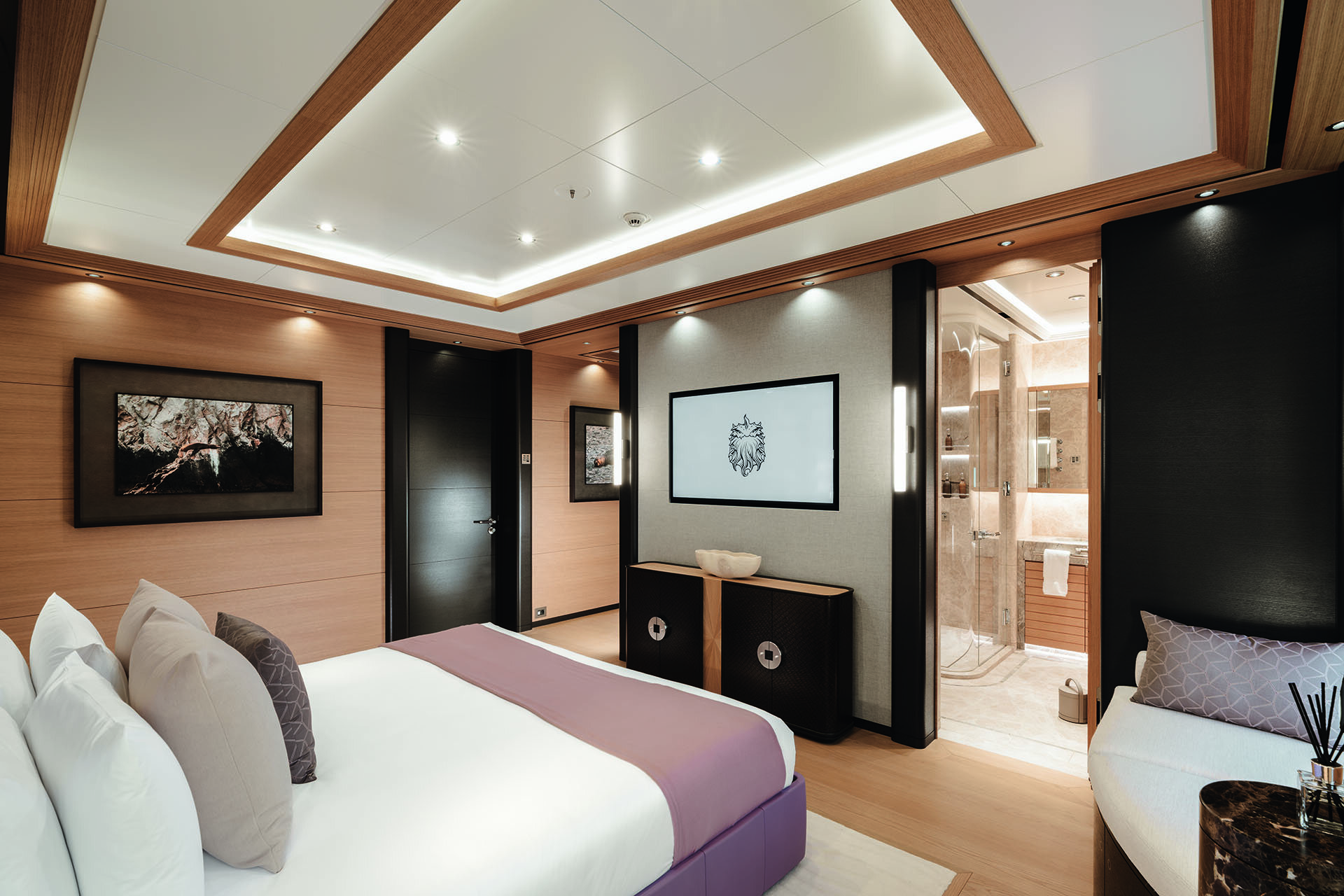
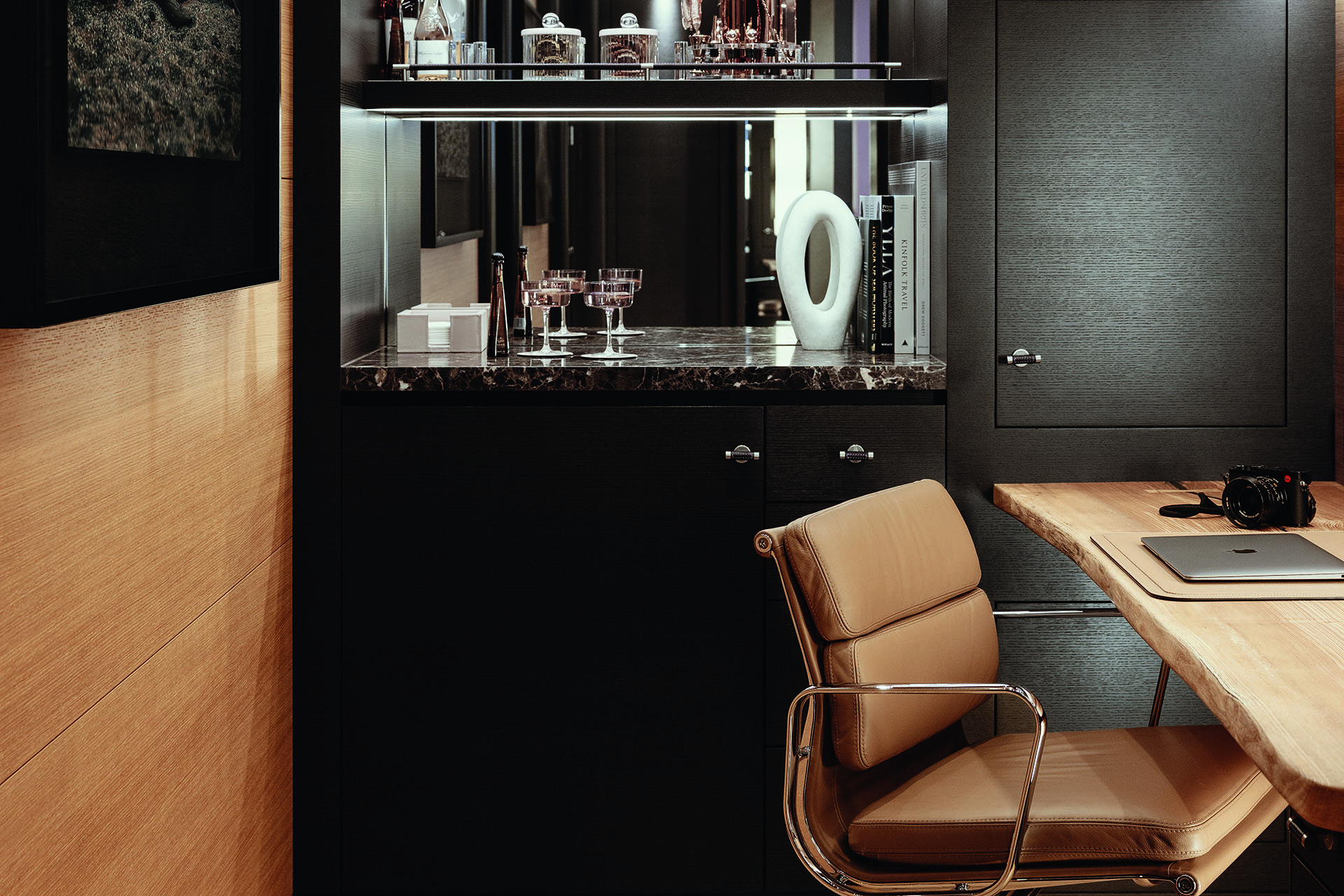

The lower-deck cabins boast very large windows (left). Oak is the prominent wood on board and it has been stained in parts for contrast. One important request from the owner to designer Mark Berryman was that all cabins should have a proper work station (right) || GUILLAUME PLISSON
The lower-deck cabins boast very large windows (left). Oak is the prominent wood on board and it has been stained in parts for contrast. One important request from the owner to designer Mark Berryman was that all cabins should have a proper work station (right) || GUILLAUME PLISSON

|| GUILLAUME PLISSON
|| GUILLAUME PLISSON

|| GUILLAUME PLISSON
|| GUILLAUME PLISSON
The technically elaborate yacht contains 420 kilometres of cables that required a dizzying number of connections to be tested. The dieselelectric system runs on AC current.
“Leviathan is equipped with 5.3MWh of battery power, allowing for extended periods of silent operation,” Swanink says. “At anchor, she can shut down all generators and run (the house systems) for up to 10 hours.”
Optimised for comfort and maintenance, the yacht has many interesting aspects. There is a “sniffer” system to detect any battery malfunction, heat waste recovery, moisture sensors, pumps to dismount interior panels without suction cups.

The beach club space has been arranged as a fully operational dive centre and toy storage area (left). Inside the electric beating heart of the diesel-electric propulsion system (right) || GUILLAUME PLISSON
The beach club space has been arranged as a fully operational dive centre and toy storage area (left). Inside the electric beating heart of the diesel-electric propulsion system (right) || GUILLAUME PLISSON

|| GUILLAUME PLISSON
|| GUILLAUME PLISSON
The two-level engine room, two-thirds of the way towards the front of the yacht, is insulated from any guest areas. The tenders are stowed in a forward garage, but a side platform (one of three) extends to provide docking space and a guest entryway. The pool has a system that prevents sloshing in rough seas. There is much more, of course, but not everything is unheard of in this category of yachts and builders . What remain unprecedented are the space allocation and level of crew involvement.
To signify the human story that underlines this build, the owner commissioned a piece of glass engraved with 3,000 names of people who collaborated on the project. It is installed on the yacht and bears the Oceanco-designed Leviathan logo, which is revealed at certain angles. Another “Easter egg”.
“I think we are quite lucky that we built a portfolio that attracts people who want to do something differently,” says Wim Verhoeff, sales director at Oceanco. And with Newell as shareholder, it’s a safe bet to assume more potential owners will come seeking to push the envelope a little further.
First published in the June 2026 issue of BOAT International. Get this magazine sent straight to your door, or subscribe and never miss an issue.


The crew's recreational deck includes a regulation-size beer pong table
Instead of an upper saloon, there is a gaming and virtual reality room
The owner enjoys a spacious suite forward with a large office
Aft of the VIP cabins is a deck with a firepit
As a tribute, glass artwork is inscribed with the names of the thousands involved in the build
A research lab lies opposite the dive centre
An AV studio is nestled on the bottom deck
LOA 111m | Speed (max/cruise) 17.6/13 knots |
LWL 102.3m | Range at 13 knots 6,500 nm |
Beam 17.8m | Fuel capacity 494,500 litres |
Draught (full load) 4.6m | Freshwater capacity 115,300 litres |
Gross tonnage 4,970GT | Tenders 2 X 11m; 1 X 7m |
Engines 2 X MTU 16V 4000 M25S | Owners/guests 12 |
Generators 3 X MTU 12V 2000 M51B | Crew 43 |
Battery pack 5.3mwh | Classification Lloyd's Register |
Stabilisers Quantum XT Fins and Quantum MagLift | Naval architecture Oceanco; Lateral Naval Architects |
Propulsion 2 X POD ABB D0980P | Exterior design Oceanco |
Construction | Interior design Mark Berryman Design |
Builder/Year Oceanco/2025 Alblasserdam, The Netherlands |
 Built with Shorthand