

LEADING LADY
How the semi-custom Benetti Lady Estey is one of a kind

Pushing the envelope of semi-custom options, the Benetti B.Now 67M Lady Estey shows off a hearty dose of bespoke design. Charlotte Thomas steps on board
Defining what makes a custom yacht isn’t as straightforward as it used to be. A true custom yacht starts with a blank canvas, but what about projects built on a proven platform that push well beyond standard semi-custom offerings in layout flexibility and bespoke styling? These yachts occupy a space that’s hard to pin down: more than semi-custom yet not quite fitting the purist definition of custom.
The answer to how to classify these yachts likely lies somewhere in between, and the flagship Benetti B.Now 67M Lady Estey is a prime example. There is commonality that will show across the line, but Benetti offers customisation enough to make each feel utterly different in finish – and, to a good extent, in layout.
Case in point, Lady Estey is actually the second hull in the Italian builder’s B.Now 67M series, following Iryna, which remains private. The highly customised sisterships showcase striking differences in interior styling, layout and amenities requested by their respective owners.
“The owner wanted to make the forward terrace something ‘wow’”

The 67’s exterior profile and general layout was developed by RWD in tandem with Benetti. The design brief was to encapsulate the B.Now philosophy, which, says Sebastiano Vida, Benetti’s head of product, embraces the inside-outside lifestyle.
“At the very beginning of the B.Now 67’s development we looked at how we could enhance the openness, the exclusivity and the well-being of guests on board in every single space,” he says. “We proposed a main deck saloon that fully opened with four sliding doors to give an indooroutdoor veranda deck feeling. We also looked at how we could embrace the Oasis Deck experience, of which the 67 is the ultimate expression.”
The 67 is essentially an evolution of the 66-metre B. Now, with improved flow and circulation, and the enhancement of one of the key Oasis Deck features – the aft pool. This now sits at an impressive six metres.

The pool on the Oasis Deck was expanded to six metres on this model. To aid the inside-outside living concept, the threshold between saloon and aft deck is flush, thanks to inverted dam construction and grated teak panels to catch any water || JEFF BROWN - BREED MEDIA
The pool on the Oasis Deck was expanded to six metres on this model. To aid the inside-outside living concept, the threshold between saloon and aft deck is flush, thanks to inverted dam construction and grated teak panels to catch any water || JEFF BROWN - BREED MEDIA
Meanwhile, the layout of the rest of the Oasis Deck – from dropdown side wings that form terraces on the water to the giant sunpads – cement this area as the core social hub for family and guests. The 67 allowed RWD to take the Oasis Deck concept to another level, says Kristian Arens, associate yacht designer at RWD.
“The idea of the deck has become central to the B.Now identity because it creates such a strong connection to the sea and surroundings,” he says. “We wanted to refine this experience even more and explore how we could push this sense of openness and flexibility.”
The emphasis on inside-outside living was reflected not only in the original layout but also in the initial interior style proposed by Sinot Yacht Architecture & Design, which embraced seamless transitions between saloons and exterior decks with a concept based on continuity of line and palette.
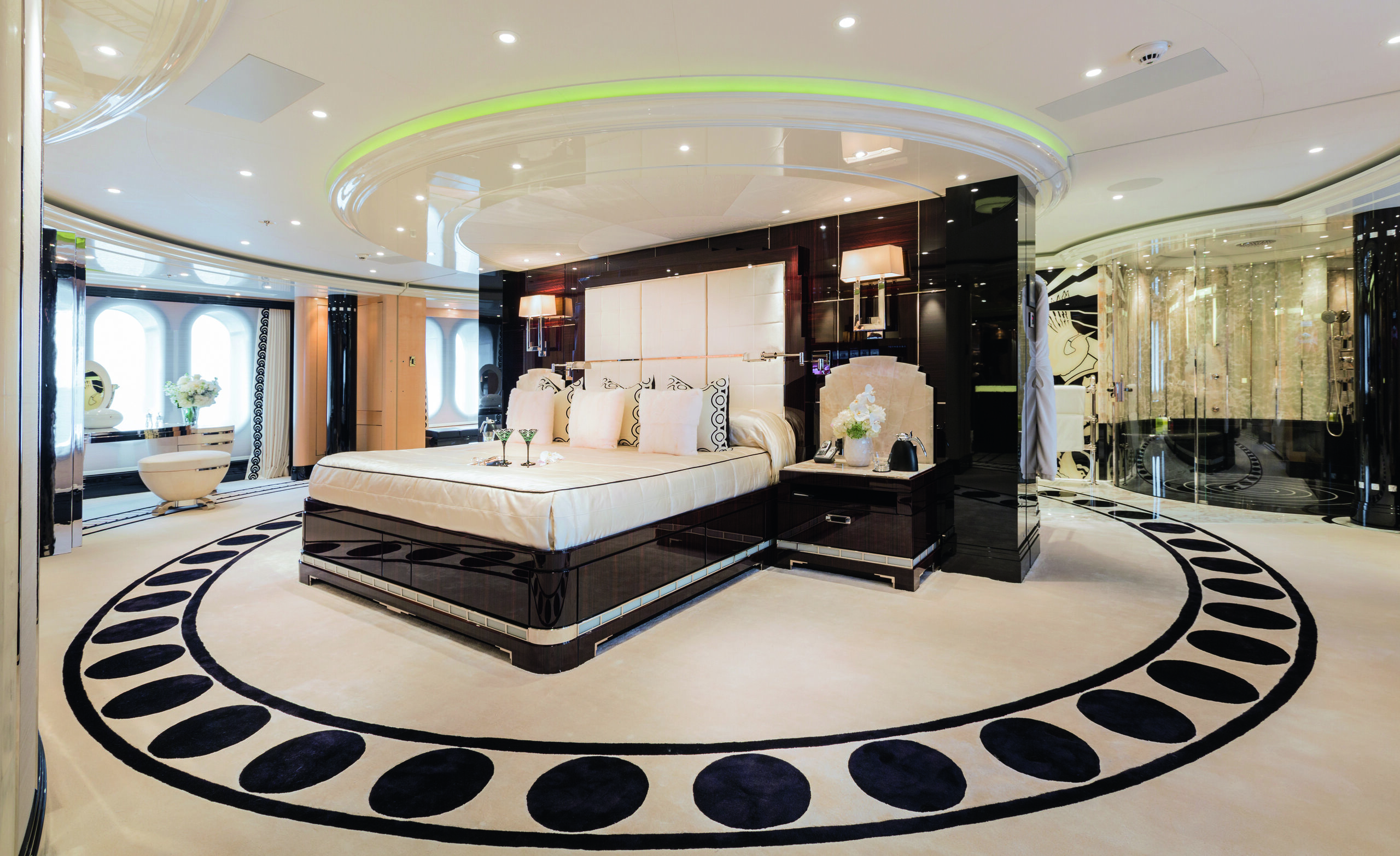
“It was a beachy style with plain colour and very natural tones,” Vida recalls. “But during the second meeting with the client, after they had signed the contract for Lady Estey, they decided they wanted interiors inspired by the 1920s Gatsby style.”
“We wanted to refine the experience even more and explore how we could push this sense of openness and flexibility”

Lady Estey’s interior design is a considerable departure from the initial concepts that were developed for the B.Now 67M. The yacht’s change to the black-and-white-oriented theme with high-gloss surfaces and prominent stainless-steel inlays meant that carrying materials and lines from inside to out was less straightforward, although the Sinot team have found ways to stretch the motif to the external areas.
The result feels like a well-executed blend of art deco decor with some more contemporary finishes. The predominantly monochrome palette draws on the interplay between pale sycamore and Bianco Lasa marble contrasted with dark ziricote and Macassar woods and Nero Marquina marble. “The complexity of the interior lies in working different materials the same way,” says Davide Siggia, senior interior designer at Sinot Yacht Architecture & Design.

“For example, the sycamore requires a different treatment to the ziricote and Macassar in order to get the same high-gloss finish, and it was hard to find a way to join the panels and make it look beautiful with a consistent gloss finish. In addition, the stainless steel had to be inlaid before lacquering the panels, adding a further complication to the surface finishing.”
The choice of high-gloss lacquer has also brought an unexpected benefit. “We found that when there were no other boats around, on the coffee table in the owners’ deck lounge you can actually see the water, which was being reflected in the deckhead,” Siggia enthuses.
“It’s an amazing effect that really creates a connection with the outside even though you are quite far from the water. We like to think of it as a planned accident.”
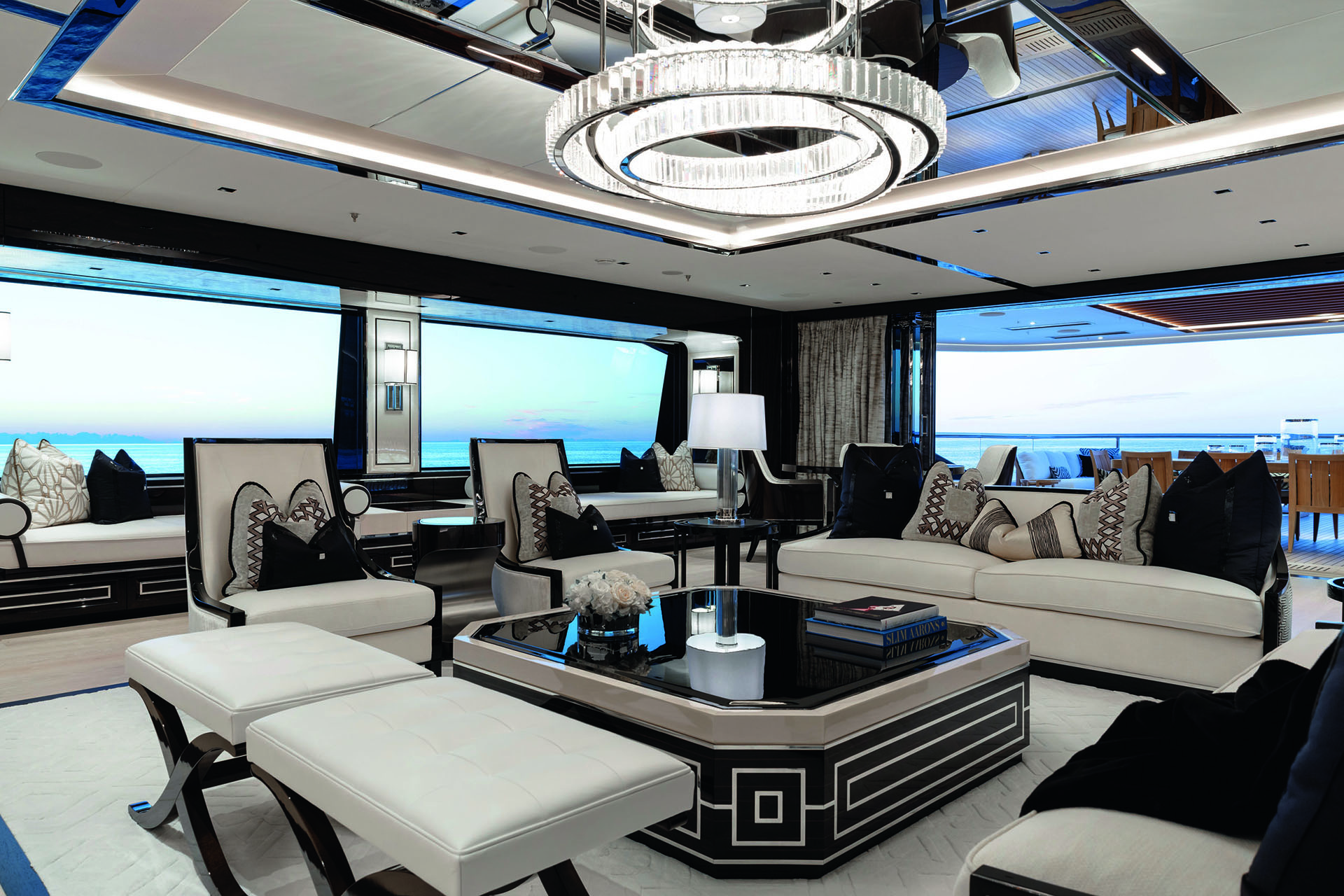
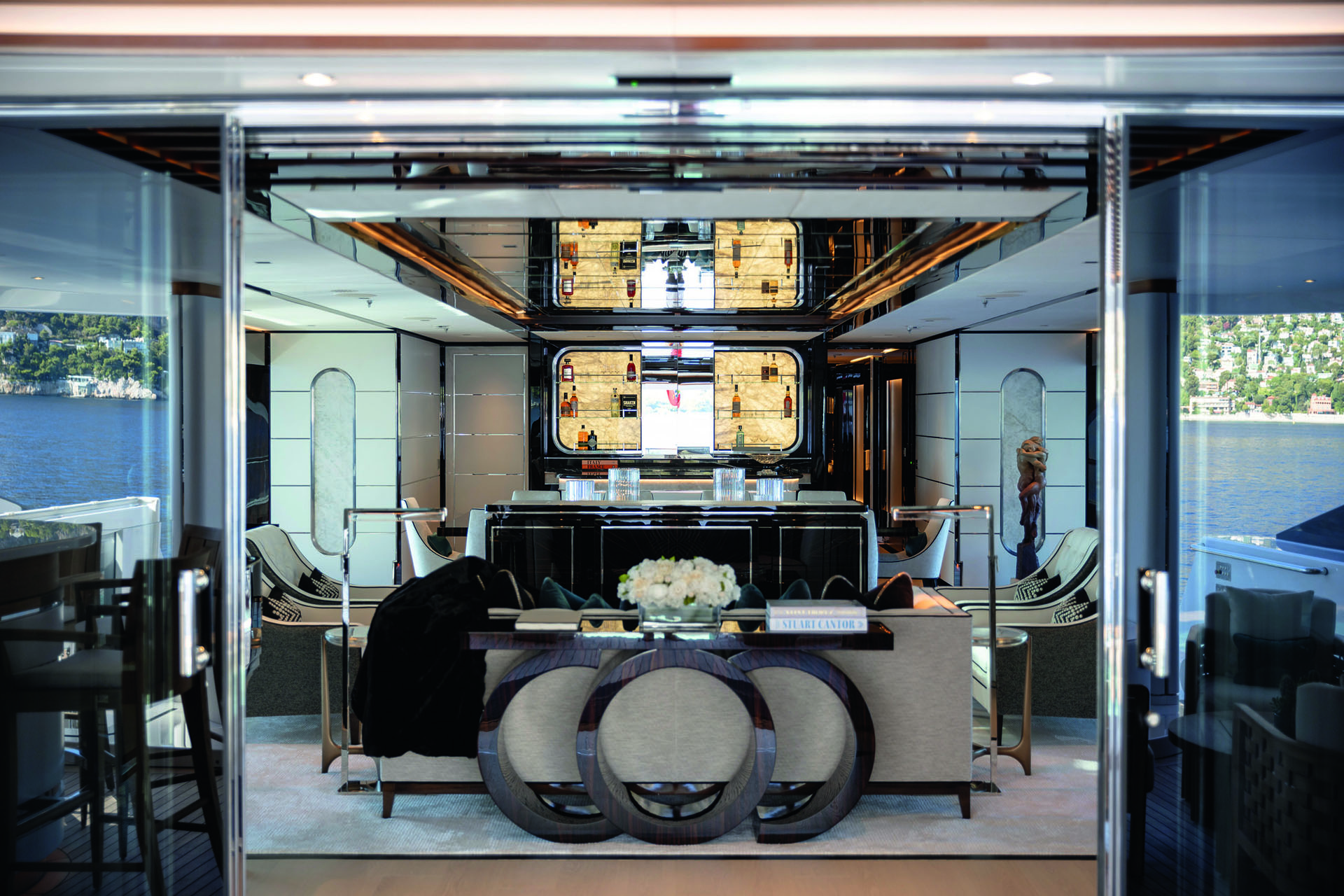
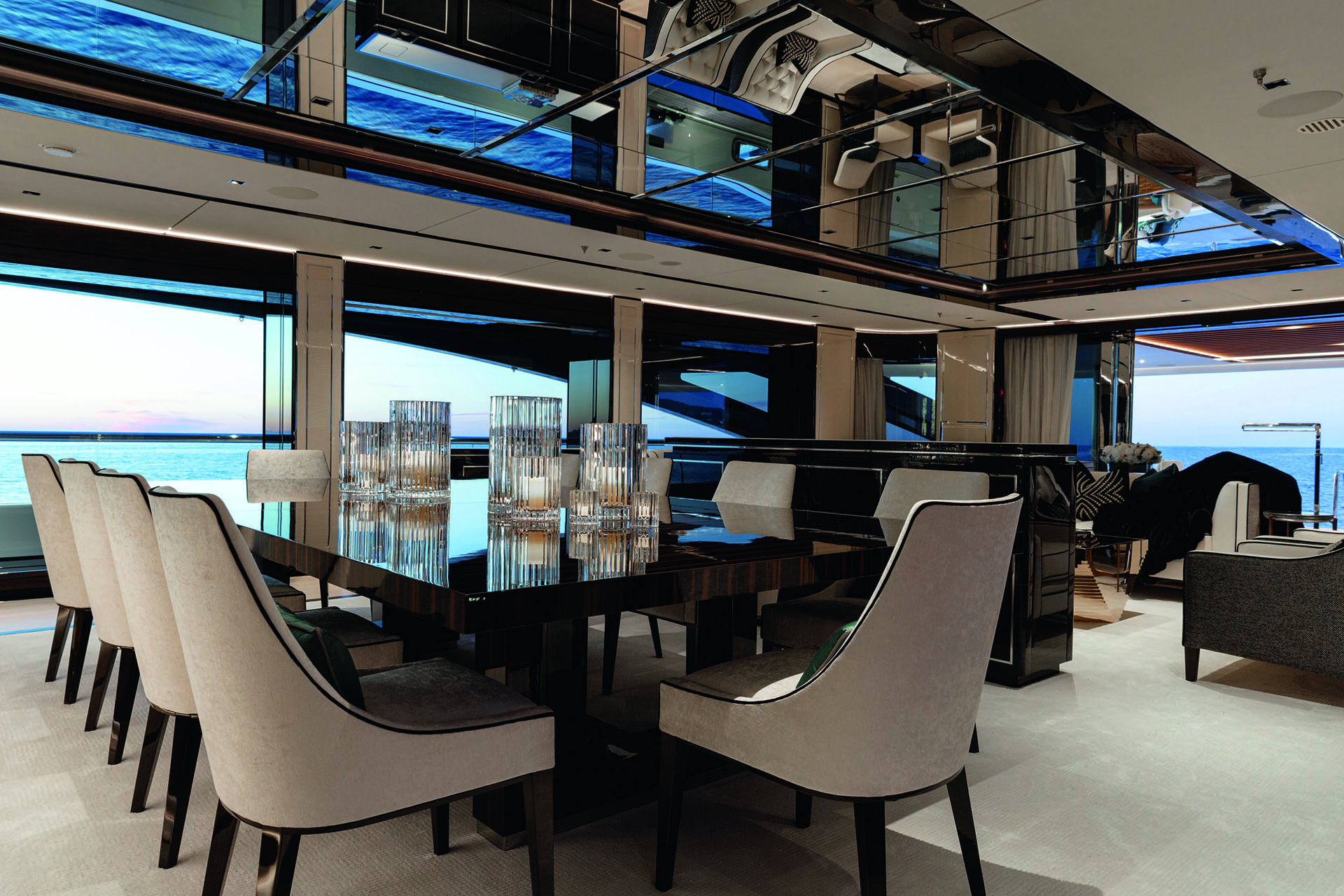
What wasn’t accidental was the choice of stonework on board – the team and the owners scoured Italy to find the right Nero Marquina marble, which is black with white striations, to match the theme. Backlit quartz also features in the main saloon’s bar backdrop and some dayheads, and the contrasting theme of the black marble with the soft white of the Bianco Lasa is replicated in the various en suites on board.
“The owners didn’t want people moving from space to space, feeling like they were on a different yacht”
The team also paid particular attention to concealing technical elements in the guest areas. “In the main saloon, that includes four fan coils and the air conditioning inlets and outlets, which often are visible in the architecture,” says Siggia.
“On Lady Estey they are hidden in the dark wood or very much recessed so guests are detached from the technical aspects of a yacht and land more into this homely feeling.”
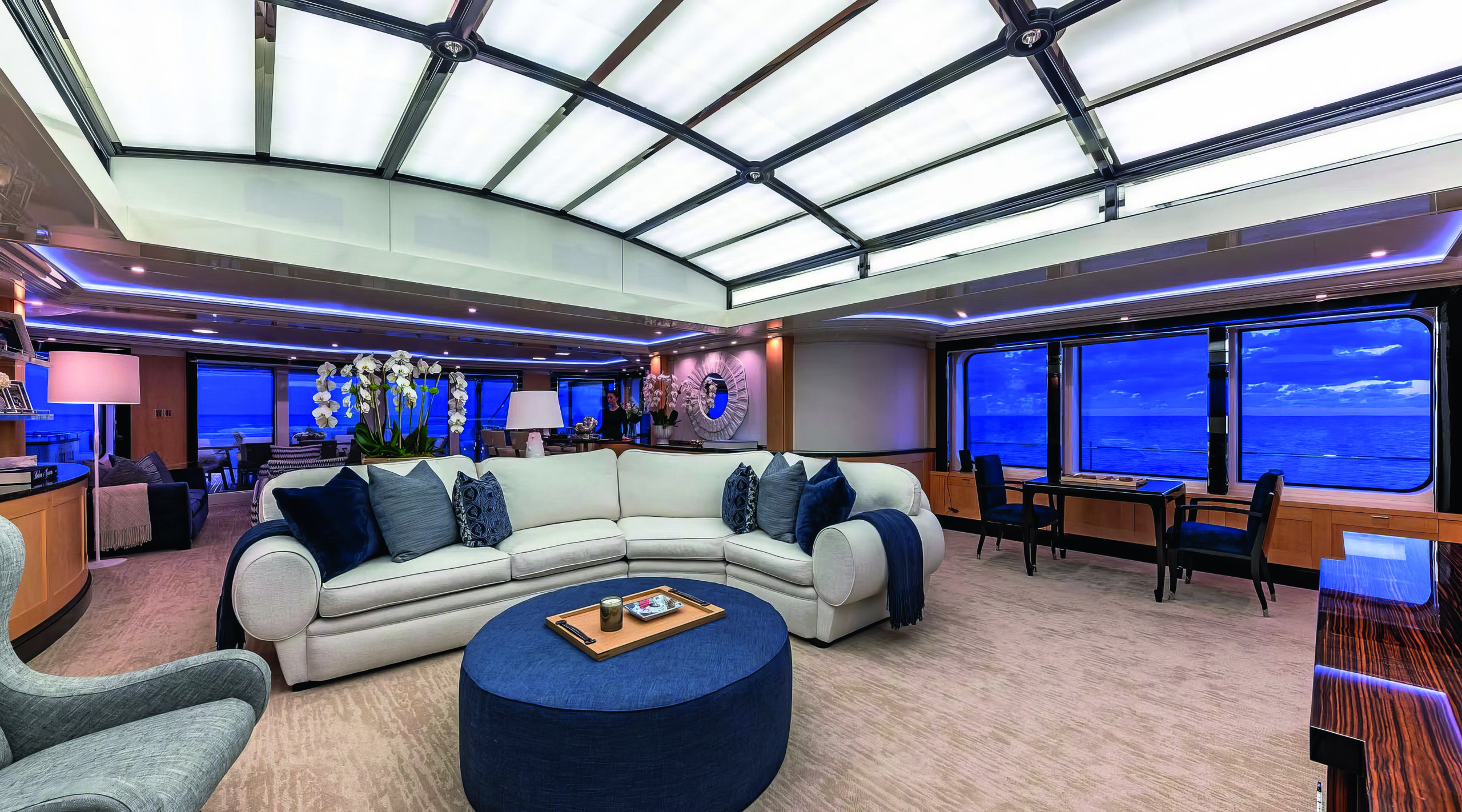
Lady Estey’s owners requested modifications to the exterior styling and layout too. “The brief was for a soft, elegant profile – something timeless,” says Arens. “There’s a real sense of refinement in the simplicity of her exterior lines. We also opened up the views with larger windows and more light, but without losing that sense of balance and proportion.”
One of the owner’s specific requests was for recessed glass caprails, which help enhance the visual flow of the yacht. “She has also been tailored for family living,”Arens adds of the yacht’s deck layout. “There are a lot more relaxed seating areas, the enlarged Oasis Deck pool, plus the owners’ custom foredeck area with sunken pool.”

|| JEFF BROWN - BREED MEDIA
|| JEFF BROWN - BREED MEDIA
Rather than opting for a more conventional arrangement, which sees mixed areas on different decks, on Lady Estey each deck serves a distinct function. The main deck is for family and friends, with six large guest suites forward and a generous saloon aft that leads out to the expansive terrace, Oasis Deck and pool area.
“There’s a real sense of refinement in the simplicity of her exterior lines”
The upper deck is given over entirely to the owner, split fore and aft of the central guest stair with the cabin forward that incorporates a lounge area and office, and a large, private full-beam saloon aft.
The owner also gets two distinct outdoor areas – a generous aft deck that, with no exterior stair access from below, can remain private; and the sweep of a foredeck lounge across the bows that offers acres of space for sunbathing, relaxing with a book or taking a dip in the pool.

The owners added a spa pool to the very top of the yacht || JEFF BROWN - BREED MEDIA
The owners added a spa pool to the very top of the yacht || JEFF BROWN - BREED MEDIA
“The owners wanted to make the forward terrace something ‘wow’, and they also asked for the specific customisation of the pool there,” Vida recalls. “It was a clever choice, and I think the overall design lends that space a charming feel.
The owners are not super young, but they are super fun. They also asked for a spa pool right on top of the yacht at the base of the mast, the perfect secluded spot for fun or private time in an exclusive spot where they can admire the horizon.”
The focused deck-by-deck layout means the lower deck can be entirely configured for the crew, with a large mess, a professional galley, crew cabins and technical spaces, plus laundry, storage and an additional crew lounge on the tank deck.
The bridge deck is split between wheelhouse, captain’s cabin and ship’s office forward and a communal aft deck with ample seating and al fresco dining for guests. The lack of a second guest saloon higher up in the yacht emphasises the distinct boundaries the owners desired, but the guest experience doesn’t suffer for it.
“The complexity of the interior lies in working different materials the same way”

“The project was developed and built around providing a guest experience to the highest level possible,” Vida asserts. That includes the six guest suites, four of which can be configured as doubles or twins, and all of which offer some 20 square metres plus large hull windows for light and views.
The layout tweaks also included turning the lower deck “adventure room” into a spa. Located aft of the engine room, it offers guests a comprehensive array of wellness and treatment options, from a large gym to a generous massage room and salon with nail bar, plus a separate area with full sauna, shower and hammam finished in Cristallo Blue quartzite.
So big is the space, Vida quips, that the team had to measure it out in a meeting room at the shipyard with tape on the floor during preliminary discussions to give the owners an idea of its scale.
Despite the distinct division in use between the decks, Sinot worked hard to ensure continuity of that style across every area of the yacht. “A key element was the flow in details and materials with the same approach to design and form language throughout the yacht,” says Siggia. “The owners didn’t want people moving from space to space and feeling like they were on a different yacht.”
While the B.Now concept offers a general layout approach and a philosophy of life on board, it’s not rigidly fixed, giving owners the opportunity to tailor elements of the general arrangement to suit.
On Lady Estey, tweaks include the location of the forward bulkhead that divides the sleeping area of the master from the rest of the cabin, and a widening of the main guest corridor forward to cater to potential future wheelchair access.

“The starboard guest corridor wall was moved 10 centimetres outboard,” says Siggia. “This also gave us a much more luxurious feeling in the corridor, which otherwise, with the choice of materials and details, could have felt a little cramped. We also found ways to incorporate alcoves for the owners’ preferred pieces of sculpture and art.”
Such changes reinforce the notion that the B.Now series offers far more flexibility than a set template on which owners simply paint their chosen style. She might be a series yacht, but Benetti certainly sees her as something more.
In Vida’s opinion, “Lady Estey is a full-custom yacht. Custom is our DNA – it’s where Benetti came from, and this is just another statement of what we can do.” Lady Estey showcases how a platform can bend to an owner’s vision and makes a compelling case for redefining the space in between.
First published in the July 2026 issue of BOAT International. Get this magazine sent straight to your door, or subscribe and never miss an issue.


A spa pool up top offers a soak with a panoramic view
Al fresco meals with guests are served on the bridge deck aft
With no exterior stair access, the owner's deck aft deck remains private
Lady Estey boasts a wider guest corridor than other models, allowing for wheelchair access
Doors between the aft deck and saloon open fully
Crew ops are clustered on the lower deck, including a very large galley
Laundry, storage and a second crew lounge are found on the tank deck
LOA 67m | Freshwater capacity 30,000 litres |
LWL 65.8m | Tenders 9.3M Ribeye; Ribeye A811; DSB 420 |
Beam 11.2m | Owners/guests 14 |
Draught 3.1m | Crew 17 |
Gross tonnage 1,334gt | Construction |
Engines 2 X 1,350KW Caterpillar 3512E | Classification Lloyd's Register |
Generators 3 X 150EKW Caterpillar C7.1 | Naval architecture Benetti |
Stabilisers NAIAD | Exterior design RWD |
Speed (max/cruise) 16/12 knots | interior design Sinot Yacht Architecture and Design |
Range at 12 knots 4,600nm | Builder/Year |
Fuel capacity 110,000 litres |
 Built with Shorthand