

CRAFT AT THE
CUTTING EDGE
Inside the winning designs of the BOAT Artistry & Craft Awards 2026

PHOTOGRAPHY: HOWARD BRUNDRETT, NATURE SQUARED, ZENA HOLLOWAY, YOSHINORI NAGASHIMA, BEN HARRIES, CHRISTOFFER RUDQUIST
Yachts may be launched amid much fanfare, but their most compelling stories are often found in the details – the timber smoked to perfection, the marquetry cut to a fraction of a millimetre, the materials shaped patiently into form. The BOAT Artistry & Craft Awards were launched to honour the makers who bring these elements to life, celebrating the knowledge, experimentation and dialogue that keep craftsmanship at the heart of great design. Holly Margerrison meets this year’s winners
THE JUDGES
DEBORAH POCOCK LVO, CEO OF QEST; LAY KOON TAN , CO-FOUNDER OF NATURE SQUARED; ADRIAN SASSOON, CONTEMPORARY ART DEALER; ANDREW WINCH, FOUNDER OF WINCH DESIGN; JAY RUSHTON, CEO OF PARKWAY ENGLAND; CHAIR: CHRISTOPHER WHALE, GROUP CREATIVE DIRECTOR OF BOAT INTERNATIONAL MEDIA
Listen: Inside the BOAT Artistry & Craft Awards: Meet the makers behind the magic
BOAT’s head of digital content Holly Margerrison goes behind the scenes of the BOAT Artistry & Craft Awards with judge and Parkway England CEO Jay Rushton, discussing this year's winners, the judging process and the future of artisan-led design in yachting. She also catches up with 2025 Emerging Artisan of the Year winner Poppy Pawsey to hear how the accolade helped shape her career one year on at British design studio Silverlining.

EVA MECHLER
Excellence in Craftsmanship
NOMINATED BY Liaigre
OBJECT Sculpted sinks, ALY501
Carved from smoked sweet chestnut and shaped with sculptural precision, the sinks on board Alia Yachts’ custom 50-metre ALY501 go against the grain in more ways than one. In a yacht environment where stone, composite and lacquer are the go-to choice for wet areas, designer and maker Eva Mechler’s hand-shaped timber basins are both a striking design statement and a technical achievement: wood, a natural material prone to movement, expansion and moisture sensitivity, transformed into functional basins designed for daily use on board.
“I have a deep appreciation of the behaviour of wood as a living material,” Mechler tells BOAT – an understanding that underpins every decision behind the project. For Mechler, craftsmanship is cumulative – shaped by formal training, decades of experience and a continuous dialogue between hand and material.
Her relationship with Liaigre began in 2016, when she first met design studio principal Guillaume Rolland at the Paris-based house. Over time, discussions evolved into commissions, including a bespoke furniture collection for Royal Huisman’s 59.7-metre sailing yacht Sarissa in 2021. That collaboration laid the groundwork for the sculpted wooden sinks aboard ALY501.

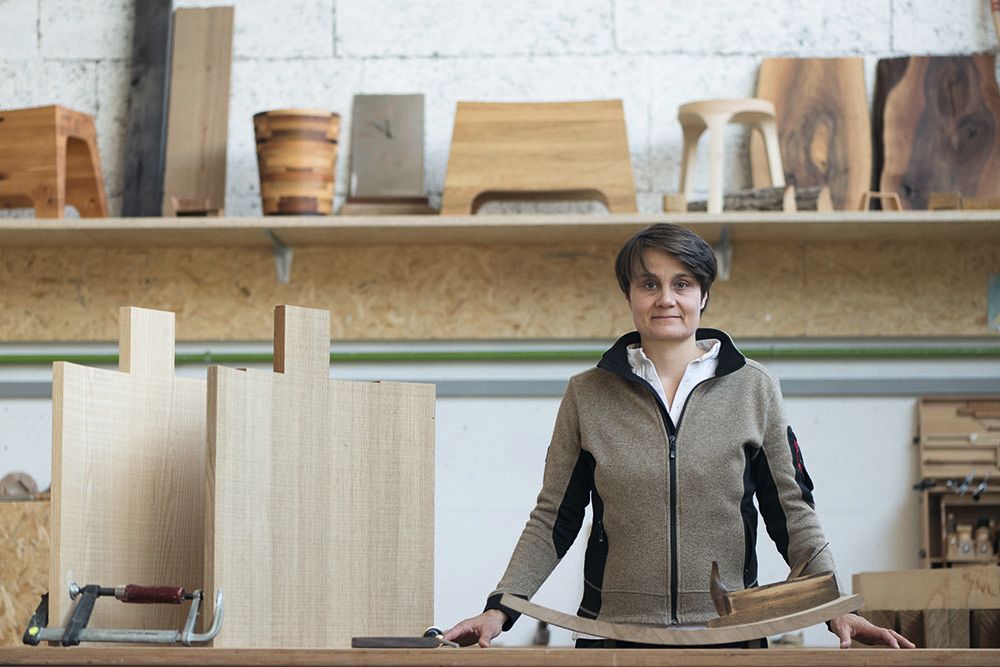
Furniture designer and maker Eva Mechler won the Excellence in Craftsmanship award for her wood sinks aboard the ALY501
Furniture designer and maker Eva Mechler won the Excellence in Craftsmanship award for her wood sinks aboard the ALY501
This year’s Excellence in Craftsmanship award follows her 2025 Judges’ Commendation for the hand-crafted “Fox” lounge chair, created using traditional woodworking techniques and sustainable wood offcuts. Both awards reflect the care and skill she brings to each piece.
Mechler trained for six years to qualify as a master furniture maker and has spent 25 years refining her understanding of timber as both structure and sculpture. Many of the hand tools in her workshop were inherited from her grandfather, a cabinetmaker, and she spent much of her childhood learning in his workshop.
Mechler’s sinks are designed “to be lived with on a daily basis”, while her aftercare methods allow crew to maintain them without specialist intervention. That knowledge is critical at sea. On board a moving yacht, materials expand and contract, humidity fluctuates and surfaces are exposed to water.
EVA MECHLER
Excellence in Craftsmanship
NOMINATED BY Liaigre
OBJECT Sculpted sinks, ALY501
Carved from smoked sweet chestnut and shaped with sculptural precision, the sinks on board Alia Yachts’ custom 50-metre ALY501 go against the grain in more ways than one. In a yacht environment where stone, composite and lacquer are the go-to choice for wet areas, designer and maker Eva Mechler’s hand-shaped timber basins are both a striking design statement and a technical achievement: wood, a natural material prone to movement, expansion and moisture sensitivity, transformed into functional basins designed for daily use on board.
“I have a deep appreciation of the behaviour of wood as a living material,” Mechler tells BOAT – an understanding that underpins every decision behind the project. For Mechler, craftsmanship is cumulative – shaped by formal training, decades of experience and a continuous dialogue between hand and material.
Her relationship with Liaigre began in 2016, when she first met design studio principal Guillaume Rolland at the Paris-based house. Over time, discussions evolved into commissions, including a bespoke furniture collection for Royal Huisman’s 59.7-metre sailing yacht Sarissa in 2021. That collaboration laid the groundwork for the sculpted wooden sinks aboard ALY501.

Furniture designer and maker Eva Mechler won the Excellence in Craftsmanship award for her wood sinks aboard the ALY501
Furniture designer and maker Eva Mechler won the Excellence in Craftsmanship award for her wood sinks aboard the ALY501
This year’s Excellence in Craftsmanship award follows her 2025 Judges’ Commendation for the hand-crafted “Fox” lounge chair, created using traditional woodworking techniques and sustainable wood offcuts. Both awards reflect the care and skill she brings to each piece.
Mechler trained for six years to qualify as a master furniture maker and has spent 25 years refining her understanding of timber as both structure and sculpture. Many of the hand tools in her workshop were inherited from her grandfather, a cabinetmaker, and she spent much of her childhood learning in his workshop.
Mechler’s sinks are designed “to be lived with on a daily basis”, while her aftercare methods allow crew to maintain them without specialist intervention. That knowledge is critical at sea. On board a moving yacht, materials expand and contract, humidity fluctuates and surfaces are exposed to water.
Her commissions begin with a sketch or drawing, which she assesses for feasibility and cost. Prototypes are produced either physically in her workshop or digitally using 2D AutoCAD and 3D SolidWorks modelling. Once samples and models are approved by the designer and owner, production begins. She liaises directly with owner representatives, shipyards and outfitters when precise installation is required.
Although she uses digital modelling and CNC routing where appropriate, the workshop remains fundamentally hand-led. “Given the choice, I prefer to create from a sketch, leading to a scale model, onto a full-scale drawing, which I use to make a unique object directly using hand tools,” she says. CNC may quicken certain stages, but “in every stage through the workshop, it is the hand, the eye and other senses, especially touch, that lead and govern the work”.
Material selection became a defining aspect of the sinks on ALY501. An exotic timber was initially considered, but Mechler proposed using a native European species instead. After experiments with pigmented ash failed to achieve the desired tonal depth, she suggested smoking sweet chestnut to darken the wood while retaining its natural grain.
The timber was exposed to naturally occurring ammonia fumes in an airtight chamber, allowing the tannins to react and deepen in colour over several days. It was then cured in a ventilated space to remove residue. The process achieved the required tone without obscuring the character of the material.
“AS I DELVED DEEPER INTO HER WORK, I WAS CONVINCED BY THE QUALITY OF EVA’S TECHNICAL SKILLS AND UNIQUE APPROACH”
GUILL AUME ROLL AND
Her approach to durability also evolved. “Years ago I would have used epoxy resins to protect the finished product,” she notes. Today, she prefers plant-based oils and waxes, which offer tactile warmth and can be more easily maintained. Mineral-oil-derived varnishes, she observes, are difficult to repair with amateur hands – one reason she favours finishes that can be cared for by crew.
Rolland describes the collaboration as smooth, combining technical expertise with Liaigre’s aesthetics. “Her excellence lies not only in the quality of the product but also in the know-how that leads to it,” he says. He recalls the satisfaction of seeing the sinks installed: “It is always rewarding to discover something you imagined taking shape and coming to life.”
For Mechler, excellence in craftsmanship lies in accuracy and commitment at every stage. “I am most proud that the owner agreed to the submission of my craftwork from ALY501 for the Excellence in Craftsmanship Award,” she says. “Thank you to BOAT and everyone.”

THE JUDGES SAID: The difficulty of working with wood in a wet environment was taken into account, as well as the precision and restraint of Mechler’s process and the craftsmanship embedded in her methods – traditions that have been passed down through her family. “I hugely admire Eva Mechler’s work with handcrafted natural timber; it is beautifully considered and incredibly refined,” said Julia Dean, senior interior designer at Winch Design.
Curator Adrian Sassoon added, “The finesse of her work is always beautiful. There’s no concession when it comes to accuracy.” Parkway England CEO Jay Rushton was most impressed by the work involved. “What stands out to me is the process behind it – the smoking of the timber, the laminating, the sealing,” he concluded.
THE JUDGES SAID: The difficulty of working with wood in a wet environment was taken into account, as well as the precision and restraint of Mechler’s process and the craftsmanship embedded in her methods – traditions that have been passed down through her family. “I hugely admire Eva Mechler’s work with handcrafted natural timber; it is beautifully considered and incredibly refined,” said Julia Dean, senior interior designer at Winch Design.
Curator Adrian Sassoon added, “The finesse of her work is always beautiful. There’s no concession when it comes to accuracy.” Parkway England CEO Jay Rushton was most impressed by the work involved. “What stands out to me is the process behind it – the smoking of the timber, the laminating, the sealing,” he concluded.
ALEXANDRA LLEWELLYN
Outstanding Collaborative Creation
NOMINATED BY Bannenberg & Rowell Design
OBJECT Custom games collection, Valor
For Alexandra Llewellyn, bespoke begins not with embellishment, but at the point of origin. “[The meaning of bespoke] has become almost like personalisation,” she reflects. “Embroidering your initials on a shirt. But we genuinely start at the very beginning every time.”
That philosophy underpins the trilogy of games she created for the 79.5-metre Feadship Valor: a circular backgammon set inspired by the zodiac; a marineinspired tournament board called Eat or Be Eaten; and an oversized solitaire set conceived for the owner’s wife. Together, they form a collection singled out for the Outstanding Collaborative Creation award – a category that celebrates not only virtuoso craftsmanship but the strength of the relationships behind it.
The collaboration between Llewellyn and Bannenberg & Rowell began years earlier, when Llewellyn first visited the studio with what the designers recall as “an early version of her portfolio of realised works: a lush combination of marquetry and gaming”.
They recall being struck immediately by her clarity of vision. There was, they say, “an erudite and artistic mind” at work – someone who understood quality instinctively. What stood out was not only the uniqueness of her pieces, but her ability to meet “the level our clientele would expect and appreciate”. In a field crowded with talented artisans, that combination is rare. “We felt an instant confidence in Alexandra’s ability,” they add. “And that meant her work stayed with us.”
ALEXANDRA LLEWELLYN
Outstanding Collaborative Creation
NOMINATED BY Bannenberg & Rowell Design
OBJECT Custom games collection, Valor
For Alexandra Llewellyn, bespoke begins not with embellishment, but at the point of origin. “[The meaning of bespoke] has become almost like personalisation,” she reflects. “Embroidering your initials on a shirt. But we genuinely start at the very beginning every time.”
That philosophy underpins the trilogy of games she created for the 79.5-metre Feadship Valor: a circular backgammon set inspired by the zodiac; a marineinspired tournament board called Eat or Be Eaten; and an oversized solitaire set conceived for the owner’s wife. Together, they form a collection singled out for the Outstanding Collaborative Creation award – a category that celebrates not only virtuoso craftsmanship but the strength of the relationships behind it.
The collaboration between Llewellyn and Bannenberg & Rowell began years earlier, when Llewellyn first visited the studio with what the designers recall as “an early version of her portfolio of realised works: a lush combination of marquetry and gaming”.
They recall being struck immediately by her clarity of vision. There was, they say, “an erudite and artistic mind” at work – someone who understood quality instinctively. What stood out was not only the uniqueness of her pieces, but her ability to meet “the level our clientele would expect and appreciate”.
In a field crowded with talented artisans, that combination is rare. “We felt an instant confidence in Alexandra’s ability,” they add. “And that meant her work stayed with us.”
Years later, the right client emerged. An obsessive backgammon player, he was, in the studio’s words, “the perfect client” for Llewellyn’s approach. Introducing them proved mutually enriching: “It’s great for Alexandra, who can build a relationship with a receptive and exacting potential client. It’s great for us to introduce a top-notch artisan whom our clients might not find easily themselves, and it can exponentially enrich our own interior design project,” the designers say.
“THE FACT THAT WE FELT AN INSTANT CONFIDENCE IN ALEXANDRA’S ABILITY MEANT THAT HER WORK STUCK IN OUR COLLECTIVE MEMORY”
BANNENBERG & ROWELL
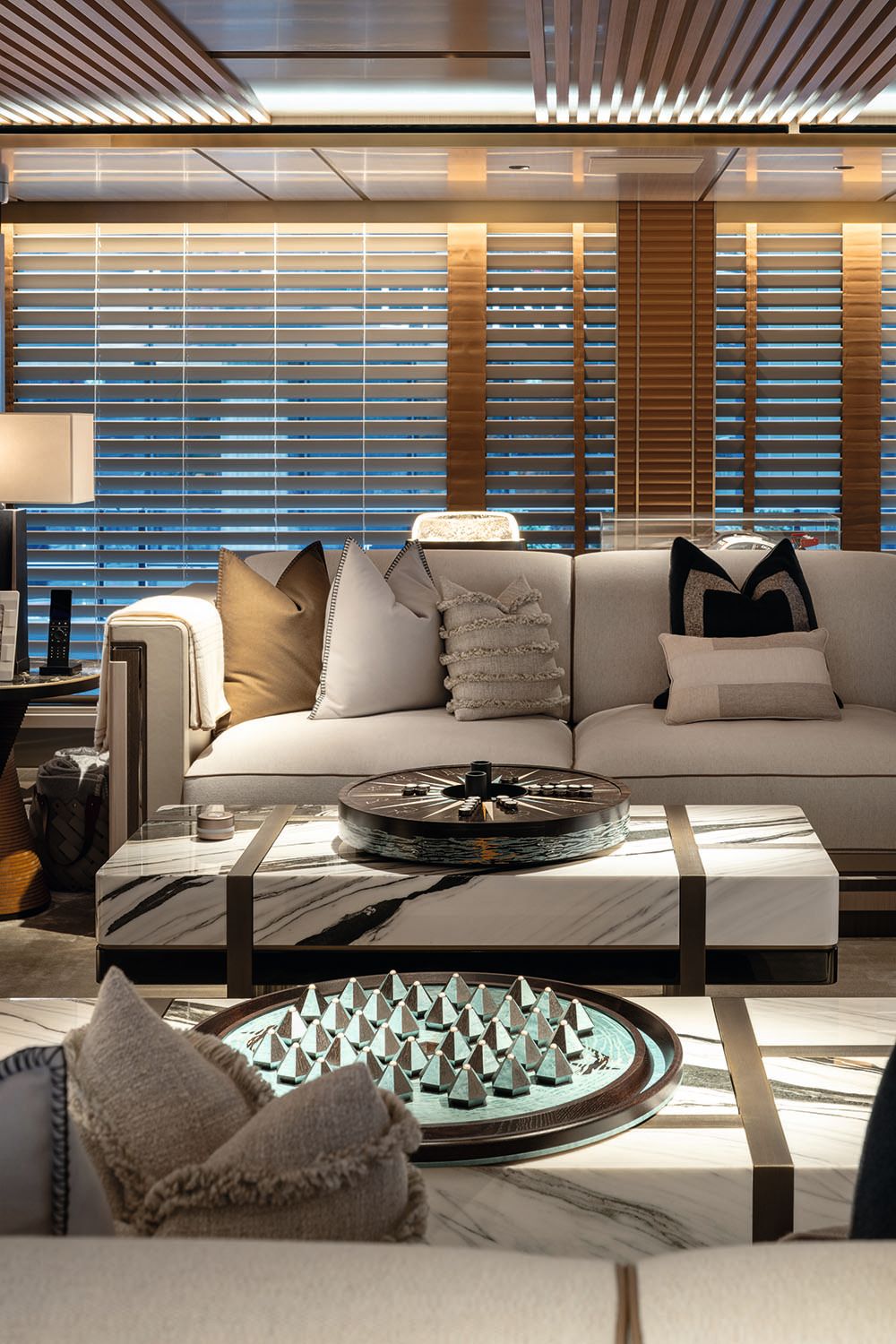
The resulting boards are materially and technically ambitious. The circular backgammon reimagines a format that has been square for millennia. “First and foremost, you’re making a game,” Llewellyn says. “It’s about geometry, balance, weight – playability.”
Its radial layout references time and navigation: 24 points for 24 hours, 12 divisions echoing zodiac signs. Silver wire and mother-of-pearl inlay trace constellations across veneers of richly figured timber, while a continuous, hand-drawn water motif wraps around the surface, achieved through intricate marquetry and shifting grain directions.
The Eat or Be Eaten board plays with life above and below deck. The exterior depicts fish and seafood enjoyed on board; the interior introduces more perilous marine creatures. The solitaire board, crafted from ancient bog oak and detailed with luminous pearls, features sharks and rays gliding across the surface. Each piece is weighted and faceted with mathematical precision to ensure stability and play at sea. “It’s got to be ultimately playable,” Llewellyn notes. “That’s inherent to the design.”
Creating these objects required an extended network of specialists. Veneer experts translated her compositions into hundreds of individually cut elements ; cabinet makers constructed the board forms; leatherworkers, metal fabricators and finishers contributed their expertise.
For Bannenberg & Rowell, the success lay in knowing when to guide and when to step back. The British studio’s senior project designer Su Fabiani ensured scale, colour and finishes aligned with the yacht’s interior before allowing Llewellyn to develop the designs directly with the clients.
“I think this represents the success of a collaboration,” the studio says. It begins with what can feel like a tentative introduction, then grows into a relationship built on trust – until the designer can step aside and let the craftsperson do what they do best.
They often return to Jon Bannenberg’s analogy of the designer as an orchestral conductor: virtuosity, he believed, is essential from every player. In this case, they describe Llewellyn simply as “a wonderful soloist”.

. The games were intricately crafted for the owners of the 79.5m Feadship Valor
. The games were intricately crafted for the owners of the 79.5m Feadship Valor
THE JUDGES SAID: The project was praised for its exceptional execution, depth of detail and the way collaboration elevated a clear design vision into a cohesive, high-quality whole.
Jay Rushton was most impressed by the technicality: “For me, this is what forms part of exceptional craftsmanship,” he said. “It’s that crazy passion for what you do and the inspiration and the story and everything else that goes with it, so that when you see the finished thing, and someone goes, ‘That’s quite nice, isn’t it?’ it’s the story behind it that magnifies it.”
Lay Koon Tan of Nature Squared praised the teamwork and use of materials: “To our concept about collaboration, where all these parties come together, it’s Alexandra’s concept and vision, but there are also all the people and all the elements involved. It’s not just the marquetry – it’s also all the materials.”
THE JUDGES SAID: The project was praised for its exceptional execution, depth of detail and the way collaboration elevated a clear design vision into a cohesive, high-quality whole.
Jay Rushton was most impressed by the technicality: “For me, this is what forms part of exceptional craftsmanship,” he said. “It’s that crazy passion for what you do and the inspiration and the story and everything else that goes with it, so that when you see the finished thing, and someone goes, ‘That’s quite nice, isn’t it?’ it’s the story behind it that magnifies it.”
Lay Koon Tan of Nature Squared praised the teamwork and use of materials: “To our concept about collaboration, where all these parties come together, it’s Alexandra’s concept and vision, but there are also all the people and all the elements involved. It’s not just the marquetry – it’s also all the materials.”
NATURE IN MOTION

The winners of the 2026 BOAT Artistry & Craft Awards were presented with bespoke trophies created by Swiss ethical design studio Nature Squared for the third consecutive year.
Founded in 2000 by Paul Hoeve and Lay Koon Tan, Nature Squared specialises in elevating discarded natural materials into refined architectural and interior applications. Inspired by the form of a vortex, the trophies symbolise the convergence of sailing, nature and artistry in a single dynamic object.
Each is handcrafted from reclaimed pearl shell, brown lip and rainbow oyster, layered with copper for rich, iridescent surfaces that shift from soft pinks and bronzes to deep inky tones and luminous white.
The shells are by-products of pearl farming and fishing. By transforming this organic waste into high-end decorative surfaces, Nature Squared supports the livelihoods of coastal communities while reinforcing its commitment to circular design. An additional Judges’ Commendation trophy was distinguished by a pyramid form.
The winners of the 2026 BOAT Artistry & Craft Awards were presented with bespoke trophies created by Swiss ethical design studio Nature Squared for the third consecutive year.
Founded in 2000 by Paul Hoeve and Lay Koon Tan, Nature Squared specialises in elevating discarded natural materials into refined architectural and interior applications. Inspired by the form of a vortex, the trophies symbolise the convergence of sailing, nature and artistry in a single dynamic object.
Each is handcrafted from reclaimed pearl shell, brown lip and rainbow oyster, layered with copper for rich, iridescent surfaces that shift from soft pinks and bronzes to deep inky tones and luminous white.
The shells are by-products of pearl farming and fishing. By transforming this organic waste into high-end decorative surfaces, Nature Squared supports the livelihoods of coastal communities while reinforcing its commitment to circular design. An additional Judges’ Commendation trophy was distinguished by a pyramid form.

ZENA HOLLOWAY
Emerging Artisan of the Year
NOMINATED BY Winch Design
OBJECT Bio-fabricated wall lights, Nasiba
For Zena Holloway, the journey to bio-fabricated lighting began underwater. Before founding Rootfull, she spent three decades as an underwater photographer, using “water as the canvas” and light as a way “to paint, but also to edit what you see”.
That instinct – to frame, guide and reshape natural forces – now underpins her work with roots. “In a way, this is also editing what you see,” she says of her wall lights for the 44.3-metre Cantiere delle Marche Nasiba. “You take the materials and then you grow in a different direction.”
Her shift from photography to biodesign was driven by environmental unease. After witnessing the decline of marine ecosystems over 30 years, she felt she could no longer tell that story through images alone.
“It’s easier to tell the positive story and get people to come with you than it is to photograph a whole load of rubbish and say, ‘Guys, this is terrible.’ Nobody wants to know.” Instead, she chose to work with materials – and with possibility. “Let’s stop mining. Let’s start growing.”
The breakthrough came during a river clean-up, when she noticed vivid red willow roots threading through the riverbank. Having previously experimented with mycelium – a root-like network of fungus – she immediately recognised their binding potential. “I just thought, those are fibres,” she recalls. “There’s a textile in that we could harness, use and grow into forms that we can design with.”
ZENA HOLLOWAY
Emerging Artisan of the Year
NOMINATED BY Winch Design
OBJECT Bio-fabricated wall lights, Nasiba
For Zena Holloway, the journey to bio-fabricated lighting began underwater. Before founding Rootfull, she spent three decades as an underwater photographer, using “water as the canvas” and light as a way “to paint, but also to edit what you see”.
That instinct – to frame, guide and reshape natural forces – now underpins her work with roots. “In a way, this is also editing what you see,” she says of her wall lights for the 44.3-metre Cantiere delle Marche Nasiba. “You take the materials and then you grow in a different direction.”
Her shift from photography to biodesign was driven by environmental unease. After witnessing the decline of marine ecosystems over 30 years, she felt she could no longer tell that story through images alone.
“It’s easier to tell the positive story and get people to come with you than it is to photograph a whole load of rubbish and say, ‘Guys, this is terrible.’ Nobody wants to know.” Instead, she chose to work with materials – and with possibility. “Let’s stop mining. Let’s start growing.”
The breakthrough came during a river clean-up, when she noticed vivid red willow roots threading through the riverbank. Having previously experimented with mycelium – a root-like network of fungus – she immediately recognised their binding potential. “I just thought, those are fibres,” she recalls. “There’s a textile in that we could harness, use and grow into forms that we can design with.”
“ZENA’S PREVIOUS EXPERIENCE WORKING IN HIGH-END FASHION AND PHOTOGRAPHY SHOWED US THAT SHE HAD A GOOD UNDERSTANDING OF THE ATTENTION TO DETAIL THAT WE REQUIRE ACROSS OUR PROJECTS”
ALEX PARKINSON
Holloway began sowing grasses onto beeswax templates carved with intricate patterns. As the roots grow downward, they follow the channels of the wax like a maze, forming a naturally interwoven textile in around 12 days. “You’re the designer, but you’re not the manufacturer,” she says. The process requires commitment, and years of experimentation have taught her how densely to sow and how to anticipate the behaviour of the roots. “There’s a language to it.” Holloway’s wall lights align with Nasiba’s low-VOC, low-synthetic brief perfectly. The finished pieces are treated with natural starches, waxes and oils. They are “ingredients I mix up in my kitchen… mostly edible”.
In a stable interior, she says, the lights can last “indefinitely” – only in compost conditions would they break down, returning harmlessly to the earth. Winch Design first discovered Rootfull at a London trade show. “We’re always looking for interesting alternatives on our projects and saw the potential to use root structures to replicate the formation of coral,” says the design studio’s sustainable materials lead and library manager, Alex Parkinson. “Holloway’s background in high-end fashion and photography reassured the studio that she understood the level of refinement required.”
Holloway began sowing grasses onto beeswax templates carved with intricate patterns. As the roots grow downward, they follow the channels of the wax like a maze, forming a naturally interwoven textile in around 12 days.
“You’re the designer, but you’re not the manufacturer,” she says. The process requires commitment, and years of experimentation have taught her how densely to sow and how to anticipate the behaviour of the roots. “There’s a language to it.”
Holloway’s wall lights align with Nasiba’s low-VOC, low-synthetic brief perfectly. The finished pieces are treated with natural starches, waxes and oils. They are “ingredients I mix up in my kitchen… mostly edible”.
In a stable interior, she says, the lights can last “indefinitely” – only in compost conditions would they break down, returning harmlessly to the earth.
Winch Design first discovered Rootfull at a London trade show. “We’re always looking for interesting alternatives on our projects and saw the potential to use root structures to replicate the formation of coral,” says the design studio’s sustainable materials lead and library manager, Alex Parkinson.” Holloway’s background in high-end fashion and photography reassured the studio that she understood the level of refinement required.”
Initially conceived as a large central lampshade, the concept evolved as Holloway and the studio worked with the material’s natural tendencies. The final design became a series of vertical wall lights, allowing the root structure to express itself more authentically. “[Winch Design] worked with me,” she says. “We collaborated with the material rather than dictating what we wanted from it.”
For Parkinson, this spirit of collaboration between designer and material is precisely what the award celebrates. Receiving the Emerging Artisan of the Year award marks a milestone not only for Holloway but also for biodesign more broadly.
“I feel incredibly honoured,” she says. “It’s a win for Rootfull, but it’s also hugely important for bio-designers and living systems designers.” In placing a grown material within the refined environment of a yacht interior, the project demonstrates that innovation and eco-conscious design can coexist – and that the future of craft may lie not in extraction, but cultivation.
THE JUDGES SAID: Holloway’s work was praised for its material innovation, biological process and originality. “Zena Holloway’s work is so innovative and unique,” said Deborah Pocock LVO, CEO of Queen Elizabeth Scholarship Trust (QEST). “What you can do and create with it is infinite in terms of its use. She’s also producing clothing and some amazing millinery with it.”
Adrian Sassoon added: “Growing your own material is extraordinary – not just for what is grown, but for what it replaces. It represents a completely new way of thinking about materiality.”
JUDGES COMMENDATIONS


YOSHINORI NAGASHIMA
NOMINATED BY Winch Design
OBJECT Cutlery set
Where are you based, and what is your studio’s speciality or signature technique? I have a production studio in Akishima City in Tokyo, Japan, where my work is centred on metal craftsmanship. A characteristic of my practice is the handcrafting of forms and expressions that would be difficult to realise through industrial approaches. I primarily work with stainless steel, aluminium and brass, and, when required, I also work with silver and other materials.
Where did you train, and how did you learn your trade? After graduating from Tama Art University, I completed a master’s degree at Tokyo University of the Arts. Then, when I completed my postgraduate studies, I began producing tableware and have developed this aspect of my work independently to the present day.
“IT IS INCREDIBLY MEANINGFUL TO ME THAT THE CUTLERY I CREATE BY HAND HAS BEEN RECOGNISED AND APPRECIATED BY SO MANY
What materials did you use, and why were they important to the final result? All of the cutlery produced for this commission was made from stainless steel. By forging each piece individually by hand from a material that possesses excellent industrial properties, I believe the work was brought to an organic and richly varied design that would not have been possible through an industrial approach.
What was the biggest challenge in executing this project? The greatest challenge was to conceive 14 new designs and to bring both beauty and usability to approximately 600 individual pieces of cutlery. Each was prototyped and used, and I repeatedly assessed whether it appealed to the senses. As a result, I believe the work has achieved a sense of harmony.
What does receiving a Judges’ Commendation mean to you personally? I am truly honoured. It is incredibly meaningful to me that the cutlery I create by hand – objects that people use in their everyday lives – has been recognised and appreciated by so many. This recognition gives me renewed confidence in my work and inspires me to continue developing my craft with even greater care and dedication.
BEST OF BRITISH
Returning as partner for the 2026 BOAT Artistry & Craft Awards, Parkway England continues its long-standing commitment to championing the artisans behind the world’s finest yacht interiors. For more than 30 years, the British furniture specialist has collaborated with leading designers and shipyards including Lürssen, Feadship and Amels, earning a reputation for precision, discretion and quietly exceptional craftsmanship.
At its 5,100-square-metre facility, a team of 50 in-house artisans work across cabinetry, marquetry, upholstery and finishing, supported by advanced CNC and laser technology. The result is furniture tailored not only to exacting aesthetic standards but also to the technical demands of life at sea.
For CEO Jay Rushton, supporting the awards is about visibility as much as celebration. “As makers, one of our biggest challenges is recognition – not for the company, but for the individual artisans and craftspeople behind the work,” he says.
“Everybody sees the finished article, but nobody sees how it was derived or the effort it takes to reach that final point.” By sponsoring the Artistry & Craft Awards, Parkway England seeks to spotlight those often-unseen contributions. “These awards help promote the artisans coming into the marketplace and give them the recognition they deserve,” Rushton adds.
BEST OF BRITISH
Returning as partner for the 2026 BOAT Artistry & Craft Awards, Parkway England continues its long-standing commitment to championing the artisans behind the world’s finest yacht interiors. For more than 30 years, the British furniture specialist has collaborated with leading designers and shipyards including Lürssen, Feadship and Amels, earning a reputation for precision, discretion and quietly exceptional craftsmanship.
At its 5,100-square-metre facility, a team of 50 in-house artisans work across cabinetry, marquetry, upholstery and finishing, supported by advanced CNC and laser technology. The result is furniture tailored not only to exacting aesthetic standards but also to the technical demands of life at sea.
For CEO Jay Rushton, supporting the awards is about visibility as much as celebration. “As makers, one of our biggest challenges is recognition – not for the company, but for the individual artisans and craftspeople behind the work,” he says.
“Everybody sees the finished article, but nobody sees how it was derived or the effort it takes to reach that final point.” By sponsoring the Artistry & Craft Awards, Parkway England seeks to spotlight those often-unseen contributions. “These awards help promote the artisans coming into the marketplace and give them the recognition they deserve,” Rushton adds.

NOMINATIONS ARE NOW OPEN FOR THE 2027 AWARDS. VISIT BOATINT.COM/BACA FOR MORE INFORMATION