

The 114.2-metre Lürssen superyacht Nausicaä has been delivered to her owner. According to BOATPro, the new build (known as Project Cosmos throughout construction) is now en route to Gibraltar.
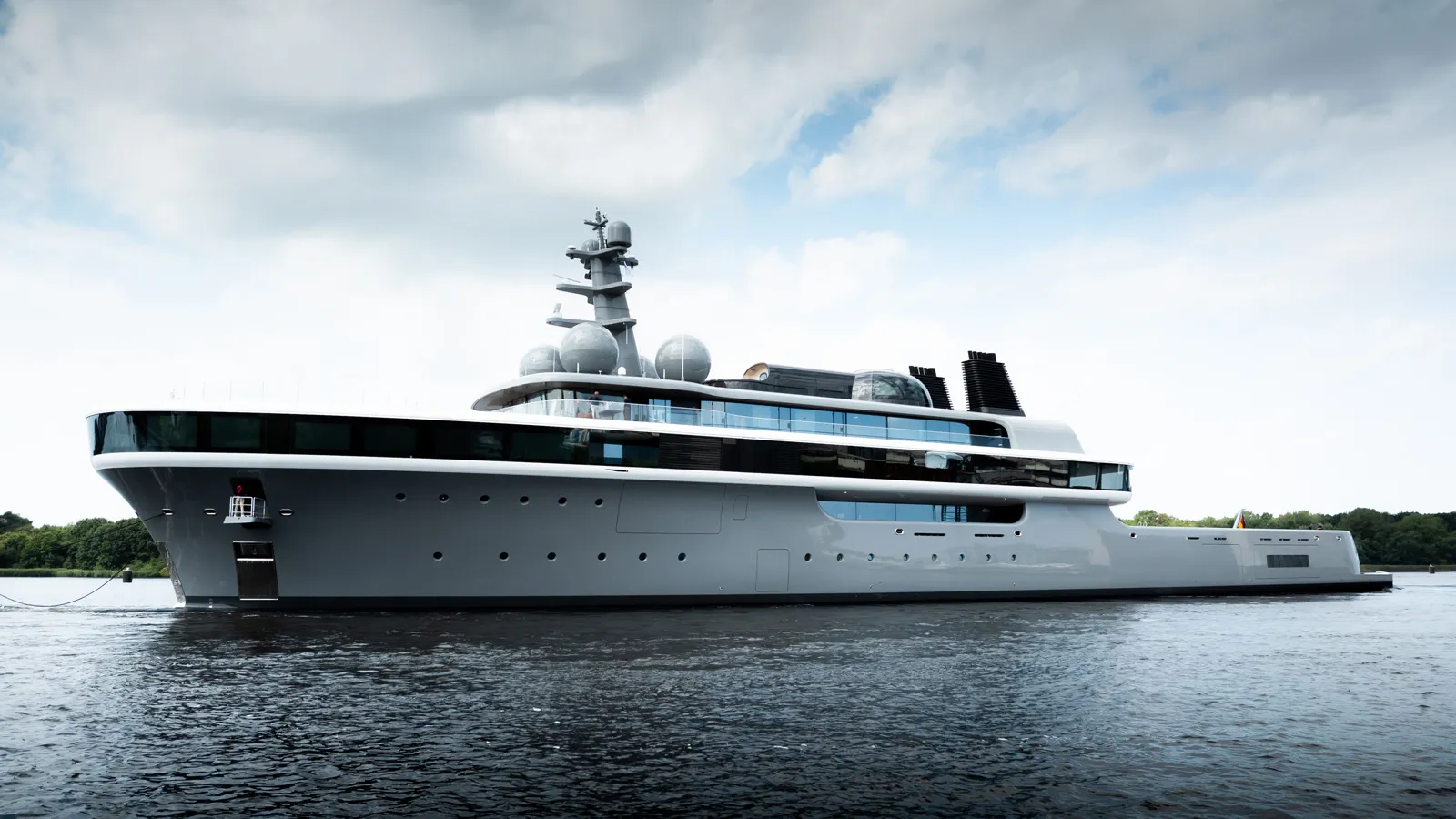
Commissioned for a Japanese owner, Nausicaä features an unusual, explorer-style profile by Australian industrial designer Marc Newson (best known for his work on the 139.7-metre Solaris), with the same designer also behind the new build's "equally striking and unconventional" interior. What makes her most recognisable is her profile shaped by curves, rounded edges and louvred details, free from flat surfaces and harsh, angular lines. "Executing this vision was an exercise in creative engineering, moulding natural and organic shapes out of unforgiving materials," the yard stated.
Central to her eye-catching appearance is the large, glass Skydome atop her profile, which is designed as a 56-square-metre private owner's study connected to a terrace. A complex feat of glass engineering, Lürssen developed a custom solution to hot-bend seven panes of thick glass (each 3,000 by 2,800mm, 62mm thick and weighing 1,050kg) to provide undisturbed 360-degree panoramic vistas and 3.15 metres of headroom inside. According to the shipyard, the process was trialled through multiple prototype bending and lamination tests on full-size mock-ups before production.
"It is extremely challenging for a design project, of any description, to literally deliver on the vision conceived and presented at concept stage,” explained Newson. “Here, I am very proud to say that every detail, at every scale, has been realised at the most coherent level. Working with an immensely creative client has enabled rare opportunities to push the boundaries and test the limits of form, material and functionality.”
The glass theme continues on her profile with a continuous glass band encasing the entire upper level – designed to provide uninterrupted views out. Here, her bulwarks, doors and technical spaces were finished in the same material to create the impression of an "uninterrupted ribbon of glass". The element culminates forward in the bow, beneath a fully-certified helipad, where there is a glass-encased, 19-metre wide observation lounge. Meanwhile, aft on the same deck, there is a circular open balcony with a glass balustrade overlooking the main deck.
Peter Lürssen, CEO of Lürssen, commented on Nausicaä's design: “Innovation in glass has long been a hallmark of Lürssen. From Rising Sun to Kismet, and now Nausicaä, we continue to push the boundaries of scale and structural complexity, creating spaces that are both aesthetically dramatic and functional for our clients. It is rare to find a modern Lürssen yacht that does not break new ground in glass engineering.”
Aside from glass, another major highlight on the six-deck superyacht is her 18-metre open aft deck, fitted with a swimming pool "deep enough for diving" and a Jacuzzi flanked by comfortable seating. The deck is connected to a dry dock that operates with a 16-tonne capacity sledge system to launch and retrieve a 12.5-metre sportsfish tender. Once deployed, the tracks retract to transform the well into a sheltered teak-lined space, with a flat hydraulic beam to close off the space.
Nausicaä is engineered for long-range, remote cruising, with an Ice Class 1D certified hull allowing her to safely operate in "light ice" conditions. The shipyard previously noted how this opens her up to the possibility of exploring "all five major oceans – and all seven continents".

Inside, the superyacht is said to feature a two-level atrium in lieu of a main saloon. Her main deck is designed as a dedicated art gallery, with custom pieces adorning the walls and a large sculpture taking centre stage. Other interior highlights include the upper aft atrium, which is dedicated to entertaining with a sushi bar, table tennis area and inlaid sofa seating.
In terms of propulsion, the new build is powered by a five-engine diesel-electric plant – two primary and three auxiliary – which drive fully electric Azimuth pods. The battery plant delivers up to 2MW, capable of powering all hotel systems simultaneously at peak load and allowing silent operation and zero local emissions for extended periods.
At the owner's request, Nausicaä has the provision of a fuel-cell system to convert methanol into hydrogen to generate electricity. "While this is an emerging technology in yachting, it is happening. And when it does, its integration will mark a major step away from traditional fossil fuels in large-yacht propulsion," Lürssen stated.
The 114.2-metre hit the water in August 2025 and began sea trials in November. Her delivery comes after four years of construction, which, according to BOATPro, began in January 2022. Anticipated key specs include a beam of 18.7 metres and a mammoth volume of 6,593GT.
"The delivery of Nausicaä has given me a profound connection to my great-grandfather, Friedrich Lürssen, who built the world's first motorboat in 1886," says Peter Lürssen. "I am incredibly grateful for that. While innovation drives everything we do, Nausicaä has truly broken new ground, just as the 6-metre Rems did 140 years ago."
According to BOATPro, there are now 11 new build projects currently in development at Lürssen, including the 101.4-metre superyacht Project Ziggy, which was sighted for the first time earlier this month at her technical launch.
Read More/101m Lürssen superyacht Project Ziggy seen for first time