

DESERT TO DHOW
Exploring Oman, from modern shores to ancient inland cities


Before the crowds arrive and cranes rise on the horizon, Catherine Fairweather sets out to rediscover the quiet magic of Oman by land and by sea – through ochre deserts, frankincense-scented souks and sea-carved coves…
SIR DON MCCULLIN
My introduction to Oman for a travel anthology, Wild Women, was written over 10 years ago. I had not been back to the country since. We touch down at the new international airport; a landmark of progressive design with glazed skylights to filter the harsh Arabian sun and the country’s largest living wall.
Our guide, Ali Al Jufaili, is waiting, immaculate in a white dishdasha and we hightail off the six-lane city highway, or “Street” as it is eccentrically called, on the 54-kilometre Muscat Expressway straight into the once inaccessible hinterland. The 7th and former capital, Nizwa, sits at the crossroads of the historic caravan routes reaching into the desert and the looming Western Hajar mountains.


SIR DON MCCULLINThe marketplace in Nizwa, the capital of Oman in the 6th and 7th centuries
SIR DON MCCULLINThe marketplace in Nizwa, the capital of Oman in the 6th and 7th centuries


The marketplace in Nizwa, the capital of Oman in the 6th and 7th centuries
Just a generation ago, the only strip of asphalt out of Muscat was the four kilometres that rolled out of the Sultan’s palace. Today, Oman boasts 3,200 kilometres of tarmac. On the airport approach, celebratory kerbsides and roundabouts are studded with fountains and the floral displays beloved by the late Sultan Qaboos. Flowers were his passion alongside horses, astronomy and opera; he built and bequeathed to the nation the grandest Opera House in Arabia.
He died in 2020, lauded for his enlightened leadership; for bringing Oman out of medieval isolationism and into the modern world. He abolished slavery, educated the populace and built hundreds of schools and hospitals, Al Jufaili tells us proudly.
“If Oman plays an important role today in the global green economy, and is a leader in the field of sustainable hydrogen energy, it is thanks to Sultan Qaboos,” he adds, aglow with that sense of national belief that is remarkable in Oman.

SIR DON MCCULLINBait Almuallem, an inn in Nizwa’s historic centre
SIR DON MCCULLINBait Almuallem, an inn in Nizwa’s historic centre


Bait Almuallem, an inn in Nizwa’s historic centre
We reach Nizwa in the early evening, in time for Al Jufaili to find a mosque to perform the Friday prayer. The historic seat of the imams, the former capital’s conservatism was so extreme it was considered too dangerous even for an explorer as adventurous as Wilfred Thesiger to visit in the late 1940s.
Any symbols of westernisation were unwelcome, including specs, sunglasses and Coca-Cola. The fizzy drink is still not available, and it continues to be “men only” at the Friday goat market, where, at dawn, weather-beaten farmers and moustachioed tribesmen with khanjar daggers strapped to their waists pile in from the countryside to sell off prize rams, lambs and bulls.
As they sit around the open enclosure, the trick is to keep a poker face. Other sections of the market are dedicated to the items Omani society sets store by: guns, daggers, dates and coffee. The arms – an intrinsic symbol of Omani manhood – fly off the stands like hotcakes.
Dates, the desert’s 6,000-year-old bounty upon which the power of this former capital was built, are used to smooth the wheels of social interaction. They are like a handshake, served at funerals, weddings or business meetings. But between thimbles of cardamom coffee, I dither over which of the 80 varieties to taste.

SIR DON MCCULLINWomen within the walls of Nizwa, a palm-treed oasis surround by the Hajar mountains
SIR DON MCCULLINWomen within the walls of Nizwa, a palm-treed oasis surround by the Hajar mountains


Women within the walls of Nizwa, a palm-treed oasis surround by the Hajar mountains
The date palm’s stamen that contains the pollen is a precious graft, wrapped in a twisted palm frond to look like a unicorn’s horn. It is weighed in the hands and wielded above the head in fevered, if good-humoured, bartering amid wafts of singed meat and burning incense.
The resin from the Boswellia sacra tree – frankincense – growing uniquely in southern Oman and Yemen, was once more expensive than gold. I buy bag loads of the ivory-tinted granules, as presents, to throw on an open hearth.
Before venturing back to Oman’s intriguing coast, we are staying at Bait Almuallem, an old, restored mansion house, reinvented as the Nomad Inn, 150 kilometres by road from the Muscat coastline.
Those visiting by superyacht can quite easily make the transition inland by dropping anchor between Muscat and Al Sawadi and making the direct journey into Nizwa. The inn lay, until recently, like the rest of Nizwa’s historic centre, as an abandoned ruin.

SIR DON MCCULLINMen at the market
SIR DON MCCULLINMen at the market
There are more up-market choices around, including Six Senses Zighy Bay and Jumeirah Muscat Bay (with superyacht access), but you won’t find something as authentic and pleasant in the historic centre. The resurrection of the 200-metre ancient wall encircling these crumbling houses is an obvious commitment to keeping history and heritage alive.
The inn’s rammed-earth structure, narrow windows and internal courtyards naturally regulate temperature in an architecture that blends seamlessly into the landscape, unrolling from below our roof terrace to the Hajar mountains.
Ancient systems and networks of canals called aflaj use gravity to irrigate the surrounding palm groves and communities. These are recognised as World Heritage, worthy of UNESCO protection. The mansion is an extension of the ancient walls that adjoin Nizwa’s famous 17th-century castle-fort, where marauders were once kept out with boiling date-syrup poured down through the “murder holes”.

SIR DON MCCULLINMen at the market examining the date palm stamen
SIR DON MCCULLINMen at the market examining the date palm stamen


Men at the market examining the date palm stamen
On this holiday Friday, the sun that sets on the honeyed stone is thankfully more of a welcome to the urban weekenders who descend in droves to stroll the ramparts, linger at the cafés and queue at the halwa stalls with the schoolchildren from the local Qur’an school. Nizwa comes alive at dusk with lanterns sparking in the ornate wall niches.

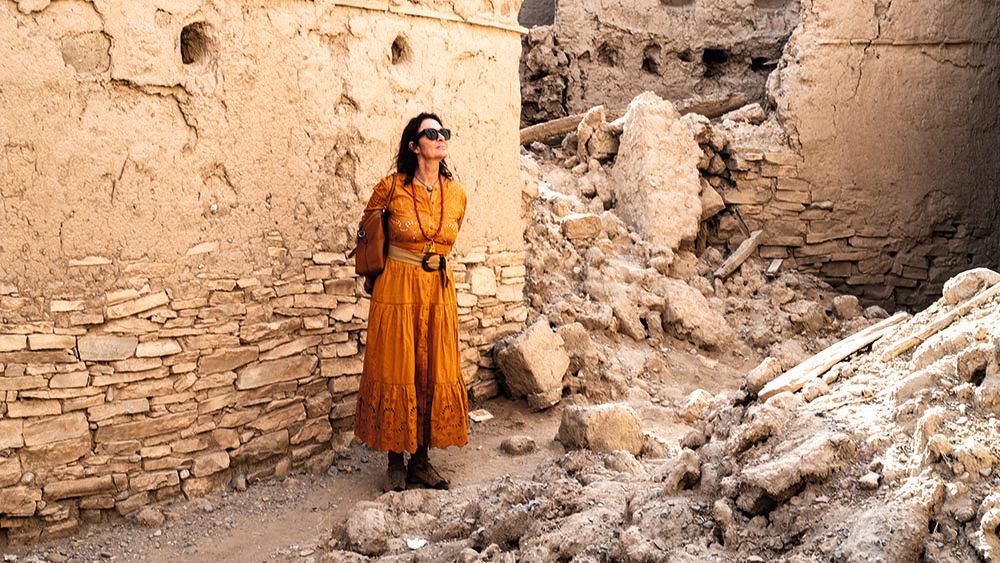
SIR DON MCCULLINCatherine Fairweather in Nizwa
SIR DON MCCULLINCatherine Fairweather in Nizwa
But before midnight, when the streets empty, the silence that falls like a curtain is absolute. It is lifted by the 5am call to prayer, when startled sparrows take flight. It is not only Nizwa that enjoys the Sultanate’s enthusiastic investment in hospitality – an effort to substitute the inevitably dwindling oil and gas reserves.
While skyscrapers and high rises are prohibited in the capital, the entire swathe of coastline running 50 kilometres from Bandar Al Khairan to Muscat is set to become shoulder-to-shoulder luxury resorts.


Historically, the dhow with its squared-off sterm, lateen sails and wooden hull were integral to the spread of the Omani empire
Ibra, a modern reincarnation of the traditional dhow
To experience the intriguing coastline, it’s best to be on the water looking back at it, so we head to Bandar Al Khairan to board the dhow Ibra. Historically, the dhow with its squared-off stern, lateen sails and wooden hull were integral to the spread of the Omani empire, on the trade routes between Africa, India and further east.
Ibra, a sleek and sophisticated reincarnation, is the latest passion project of Millfield-educated, HH Sayyid Taimur bin Shabib Al Said, a relation of the late Sultan. The head of Hud Hud, Oman’s leading purveyor of private tented camps and expeditions, Al Said acknowledges that dhow charters are a departure from his script. He wanted to pay homage both to cherished memories of childhood holidays afloat and to the extraordinary maritime heritage of Oman.
To experience the intriguing coastline, it’s best to be on the water looking back at it, so we head to Bandar Al Khairan to board the dhow Ibra. Historically, the dhow with its squared-off stern, lateen sails and wooden hull were integral to the spread of the Omani empire, on the trade routes between Africa, India and further east.
Historically, the dhow with its squared-off sterm, lateen sails and wooden hull were integral to the spread of the Omani empire
Ibra, a sleek and sophisticated reincarnation, is the latest passion project of Millfield-educated, HH Sayyid Taimur bin Shabib Al Said, a relation of the late Sultan.
The head of Hud Hud, Oman’s leading purveyor of private tented camps and expeditions, Al Said acknowledges that dhow charters are a departure from his script. He wanted to pay homage both to cherished memories of childhood holidays afloat and to the extraordinary maritime heritage of Oman.

SIR DON MCCULLINRamadan banquet set on the lawn of The Chedi Muscat
SIR DON MCCULLINRamadan banquet set on the lawn of The Chedi Muscat
Ibra is a grand proposition, a new concept for Oman; a modernised, yet authentic dhow that is more of a superyacht. Available for exclusive charter with a crew of five, Ibra is a 32-metre vessel, with cocoa-coloured hull and creamy double decks.
When our scuba-diving adventure to the marine reserve of the outlying Dimaniyat Islands is scuppered due to rough seas, we explore the calm inlets of the Bandar Al Khairan instead. On my stand-up paddleboard I can see hawksbill turtles somersault in the clear water below, coming close enough to touch when I jump in with a mask and snorkel.
We enjoy a candlelit dinner on Ibra’s decks, suspended magically in a puddle of light that makes the surrounding inky sea and shadows of the rocky promontory, 95 million years old, seem blacker.
But when the vast Anantara resort opens next year at Bandar Al Khairan – another pearl on the necklace that strings a JW Marriott, Kempinski, Shangri La, Mandarin Oriental together along this coast – will that sense of remote and glorious isolation be forever lost? A yacht still seems the best way to combat the notion.


For Oman, the transition from rugged wilderness to lively Riviera and luxury tourism hotspot is rapid and ongoing
The Chedi Muscat, built in 2002, was the city’s first destination resort
For Oman, the transition from rugged wilderness to lively riviera and luxury tourism hotspot, from backwater to vital geopolitical hub, is rapid and ongoing. In 2002, when the flagship Chedi Muscat was built on Al Ghubra beach outside Muscat as the city’s first destination resort, blending modern and low-slung traditional design, there were only a few fisher’s shacks and seagulls for neighbours.
Today, from my sumptuous Chedi beach bed, I watch Boeings take off over the shoreline. And yet the appeal of Oman, which is indeed the appeal of The Chedi, is the sense of essential timelessness and remove; the strength of an identity rooted in heritage and tradition.
It is Ramadan, and Muscatites are pouring into The Chedi for the break of fast. The crepuscular space of the vast domed entrance has all the hallucinatory quality of an opium dream, enhanced by the frankincense-filled air and reflective blackoxide floor that is like walking on water. The Ramadan banquet is set out on a festive lawn strung with fairy lights, ring-fenced with flares and water.
JeanMichel Gathy’s design, which echoes the irrigation channels or aflaj of the ancients, is all about water; pooling into lotus-fringed ponds, spouting into fountains and flowing like a stream beneath stepping-stone walkways.
In the seething cauldron of discontent that is currently the Middle East, The Chedi is perhaps that ultimate oasis and Oman the refuge and bastion of calm that we are looking for. But I remain convinced that travelling these ancient shores by superyacht (or dhow) and ducking into the desert to experience the clamour of the culture is the best way to visit Oman.
First published in the January 2026 issue of BOAT International. Get this magazine sent straight to your door, or subscribe and never miss an issue.
 Built with Shorthand